Being the dial plates, psychographs and spirit wheels that followed the Professor's spiritoscope into the patent offices of London and Washington, from 1854 to 1983; with their drawings, and the patents themselves to read in full.
London · Washington · 1854 to 1983
I.Before the Patents
The first dials were never patented, so far as I can find. Isaac T. Pease of Thompsonville, Connecticut, made his Spiritual Telegraph Dial in 1853, borrowing the face and needle of the dial telegraph: the alphabet round the rim, the digits and a ring of stock answers within, and a needle to point to them. Professor Hare took that dial, joined it to his lever and stand, hid it from the medium behind a screen, and published the whole in 1855 as the Spiritoscope, with the engravings you will find on the first page of this house. In Paris, Allan Kardec described a dial lettered like an electric telegraph in his book on mediums of 1861. In Ohio in the 1880s, Hudson Tuttle sold a dial printed on card, on ball bearings, for a dollar and a quarter, and called it the Psychograph, or Dial Planchette. None of these, as far as I have been able to discover, was ever patented. They were published, advertised and copied.
The patent office first hears of the idea in London. On the 23rd of January 1854, Adolphus Theodore Wagner applied for a British patent, number 173 of that year, for a Psychograph, or Apparatus for Indicating Persons' Thoughts by the Agency of Nervous Electricity. I do not hold a scan of it, and I will not pretend to describe a drawing I have not seen; the title alone shows where the century was heading. The word psychograph was taken up by dial makers, and was still being granted in Washington in 1983.
II.The Dial Plates
20 patents, from 1880 to 1973, for one problem: how to turn the hesitant push of a sitter's hand into an answer the whole table can read. Some move a pointer over the letters, some move the letters under a pointer, and some straighten the dial into a line. Click any sheet to see it full size.
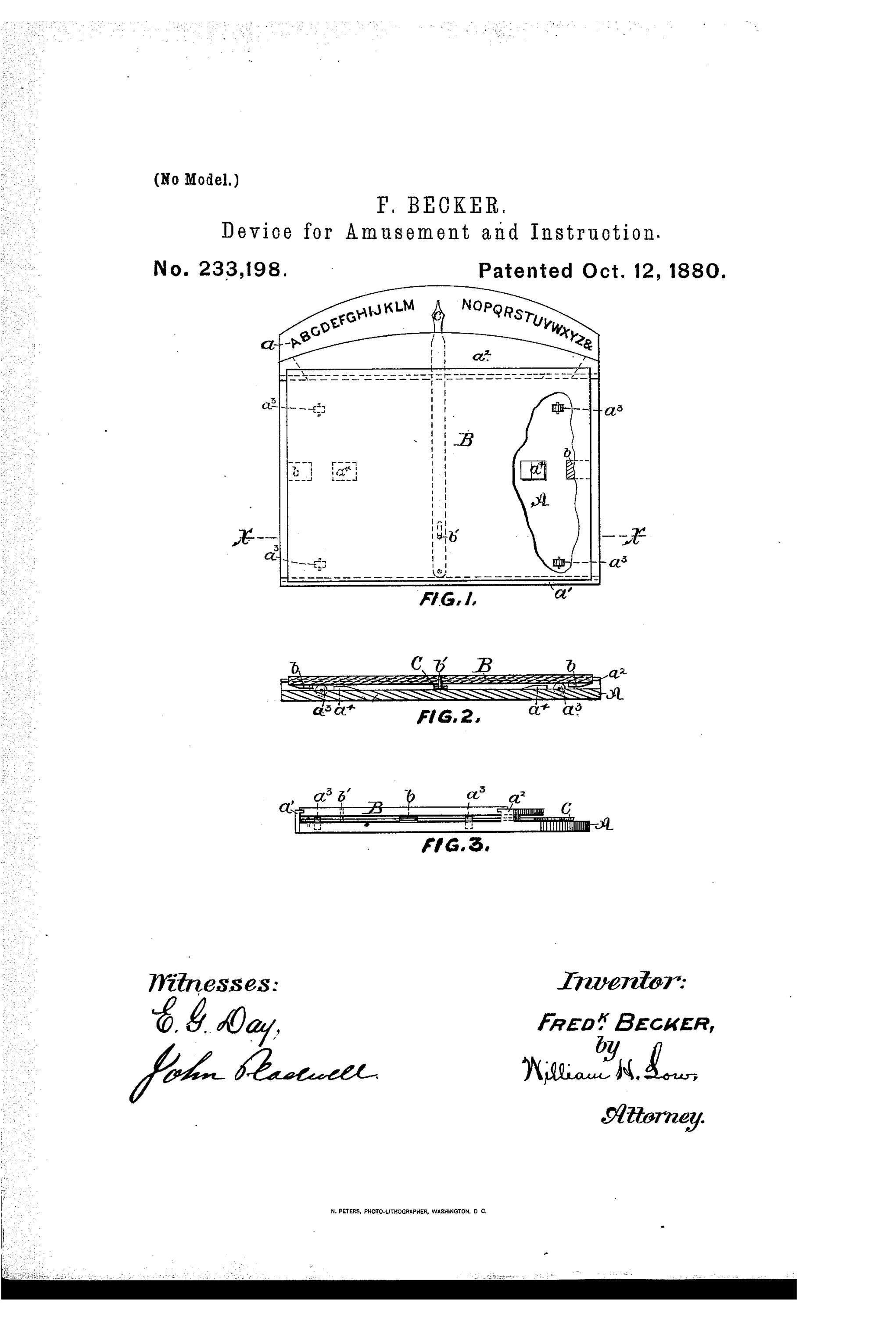
Device for Amusement and InstructionUS 233,198 · Frederick Becker, Albany, New YorkFiled 7 September 1880 · granted 12 October 1880 A top piece slides in guides over a wooden base, riding on antifriction rollers between stops. A pin on it carries a pointer, pivoted at the inner end of the base, along an alphabet at the edge: the sitters push the slide, and the pointer chooses the letter. The full patent (PDF, 127 KB) · Google Patents
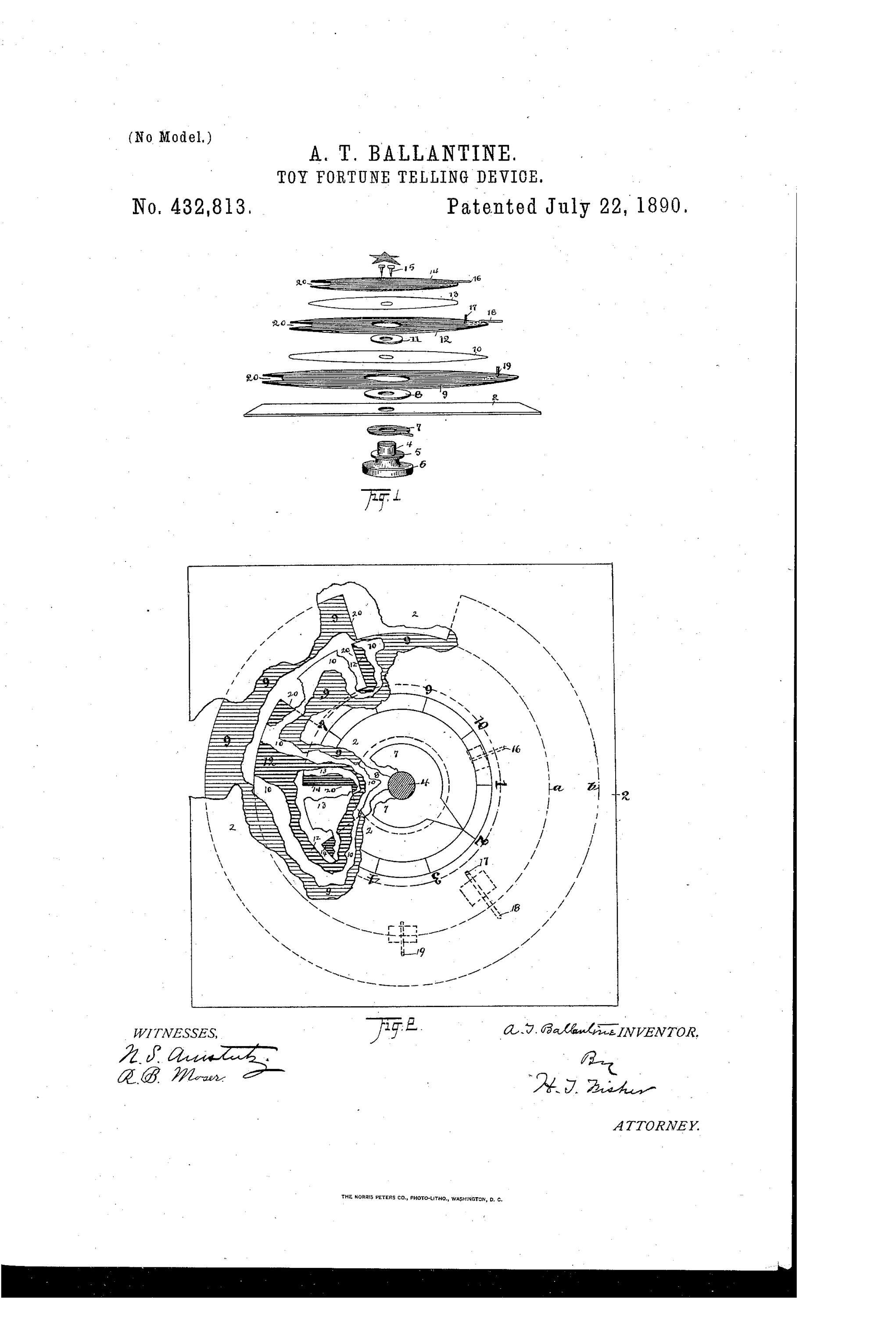
Toy Fortune-Telling DeviceUS 432,813 · Alexander T. Ballantine, Cleveland, OhioFiled 9 August 1889 · granted 22 July 1890 A card dial numbered one to ten, with a pointer turned by a central spindle and button. Stacked on the spindle are fixed cards printed with readings and turning cards cut with recesses, so that each setting of the pointer uncovers one reading on each fixed card. The full patent (PDF, 413 KB) · Google Patents
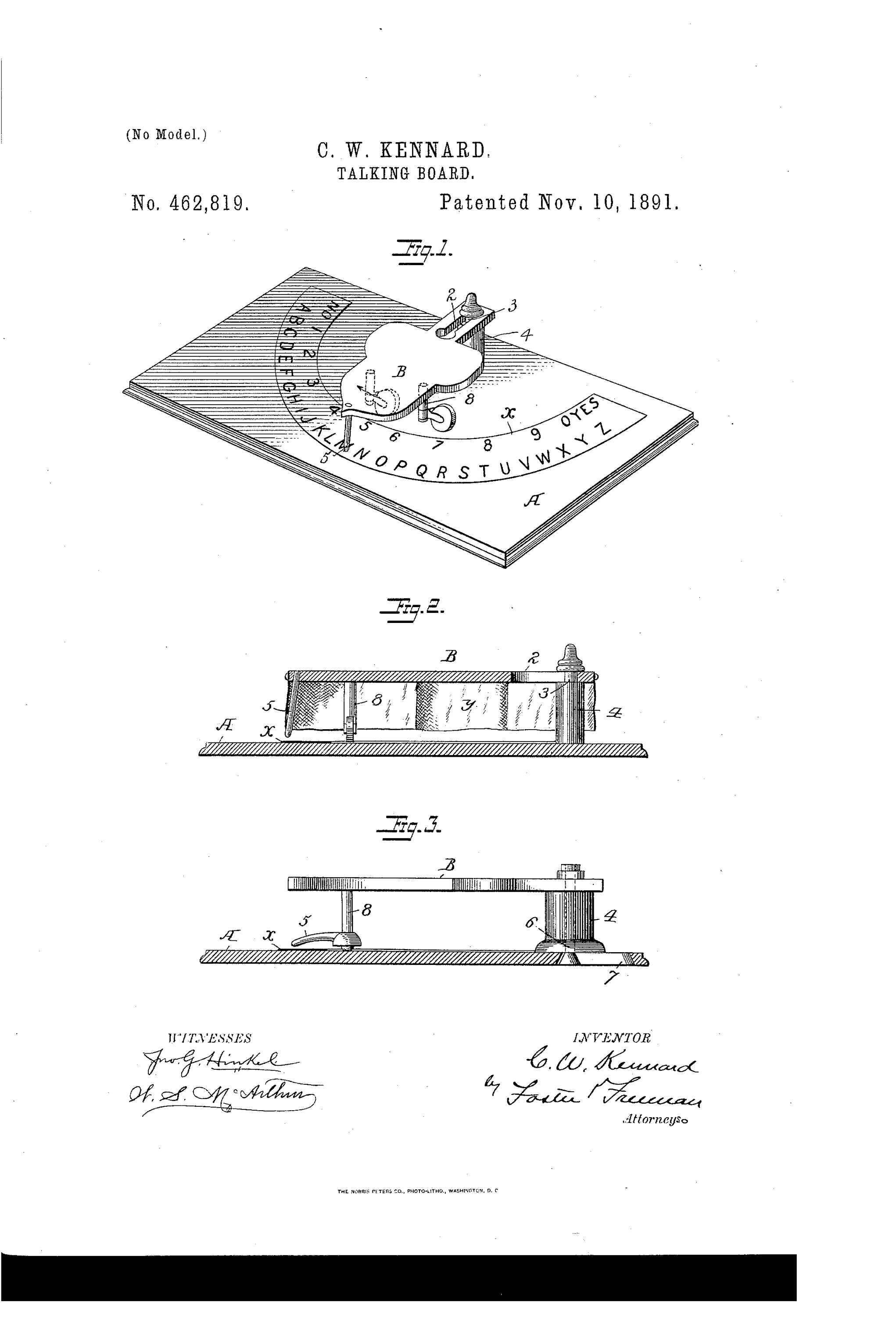
Talking-BoardUS 462,819 · Charles W. Kennard, Baltimore, MarylandFiled 18 February 1891 · granted 10 November 1891 Kennard's improvement on the Ouija board of the same year, never put into production: the letters laid along concentric curves, and a pointer table on castors held by a pin in a slot, so that it can only swing and slide radially: a talking board with the discipline of a dial. The full patent (PDF, 237 KB) · Google Patents
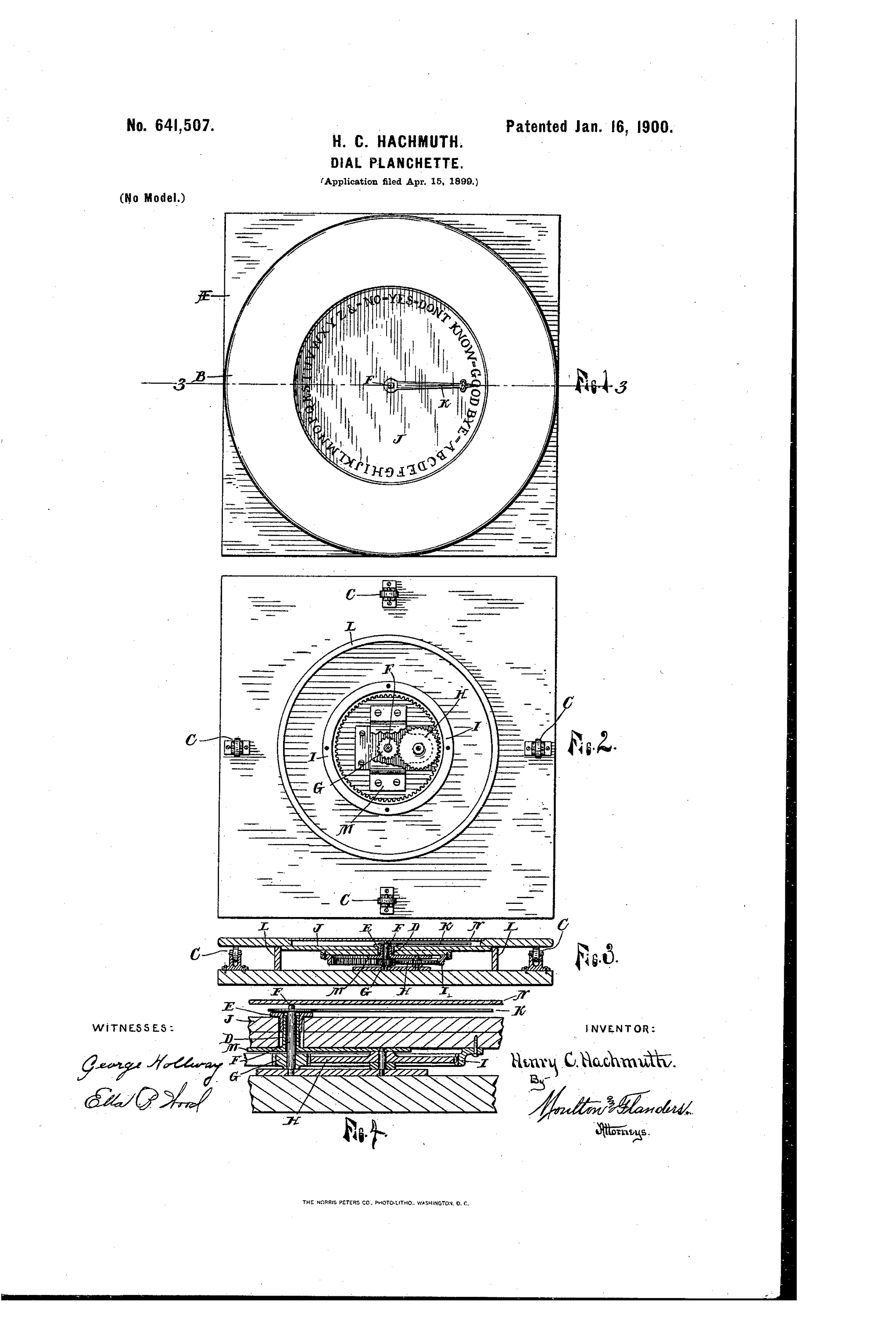
Dial-PlanchetteUS 641,507 · Henry C. Hachmuth, Mill Creek, Kent County, MichiganFiled 15 April 1899 · granted 16 January 1900 The fullest of the dial planchettes. The alphabet, with Yes, No, Don't Know and Good Bye, lies in a sunken dial under glass. The hands rest on a turntable geared through a pinion and an internal ring to the index on the central shaft, so that a small turn of the table sweeps the index right round the dial, the other way. The full patent (PDF, 212 KB) · Google Patents
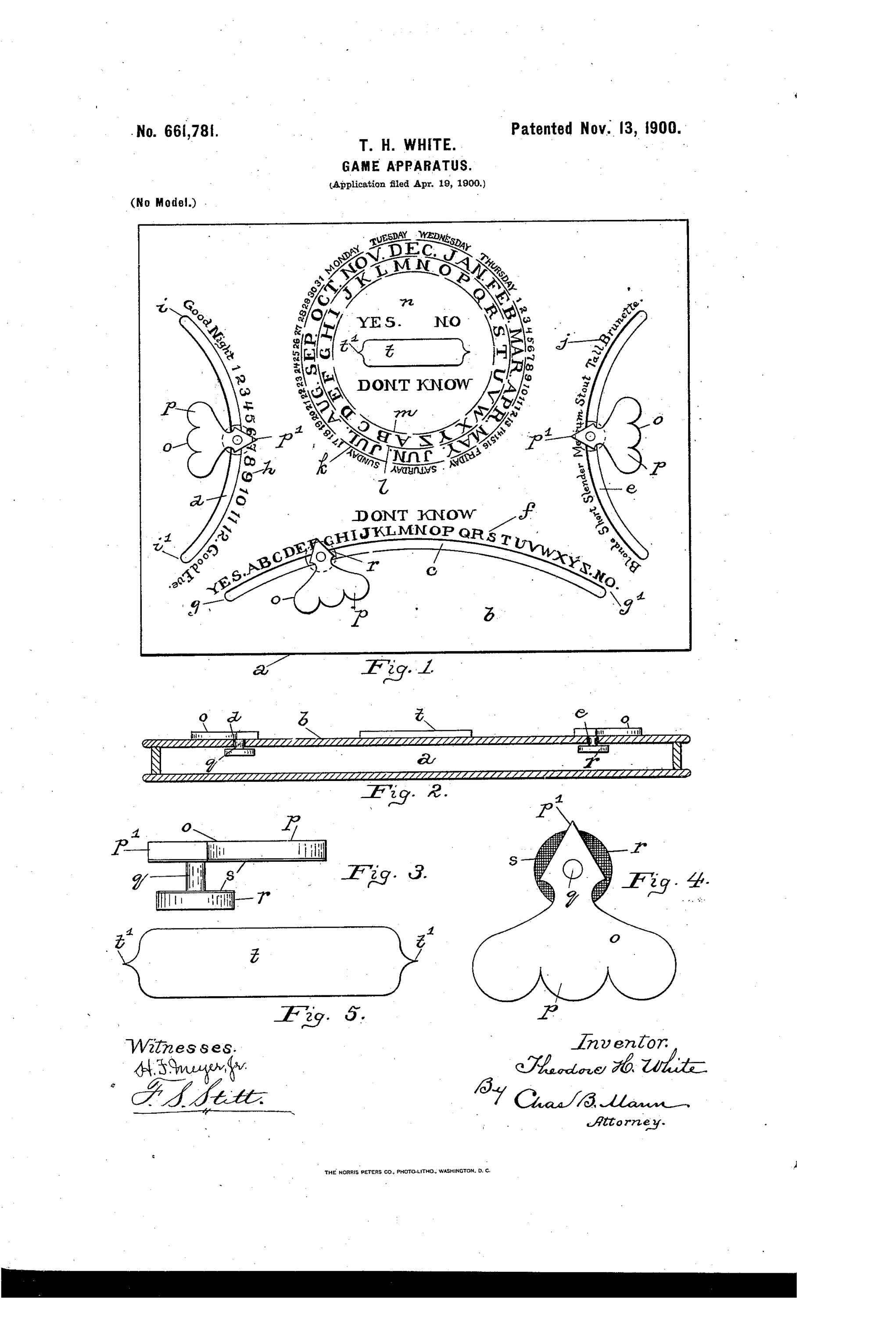
Game ApparatusUS 661,781 · Theodore H. White, Baltimore, MarylandFiled 19 April 1900 · granted 13 November 1900 A cabinet whose top is cut with curved slots bordered by letters, words and numerals, each with a sliding pointer on a guide pin, and a separate two-pointed indicator moving over concentric circles of letters, days and months. The full patent (PDF, 230 KB) · Google Patents
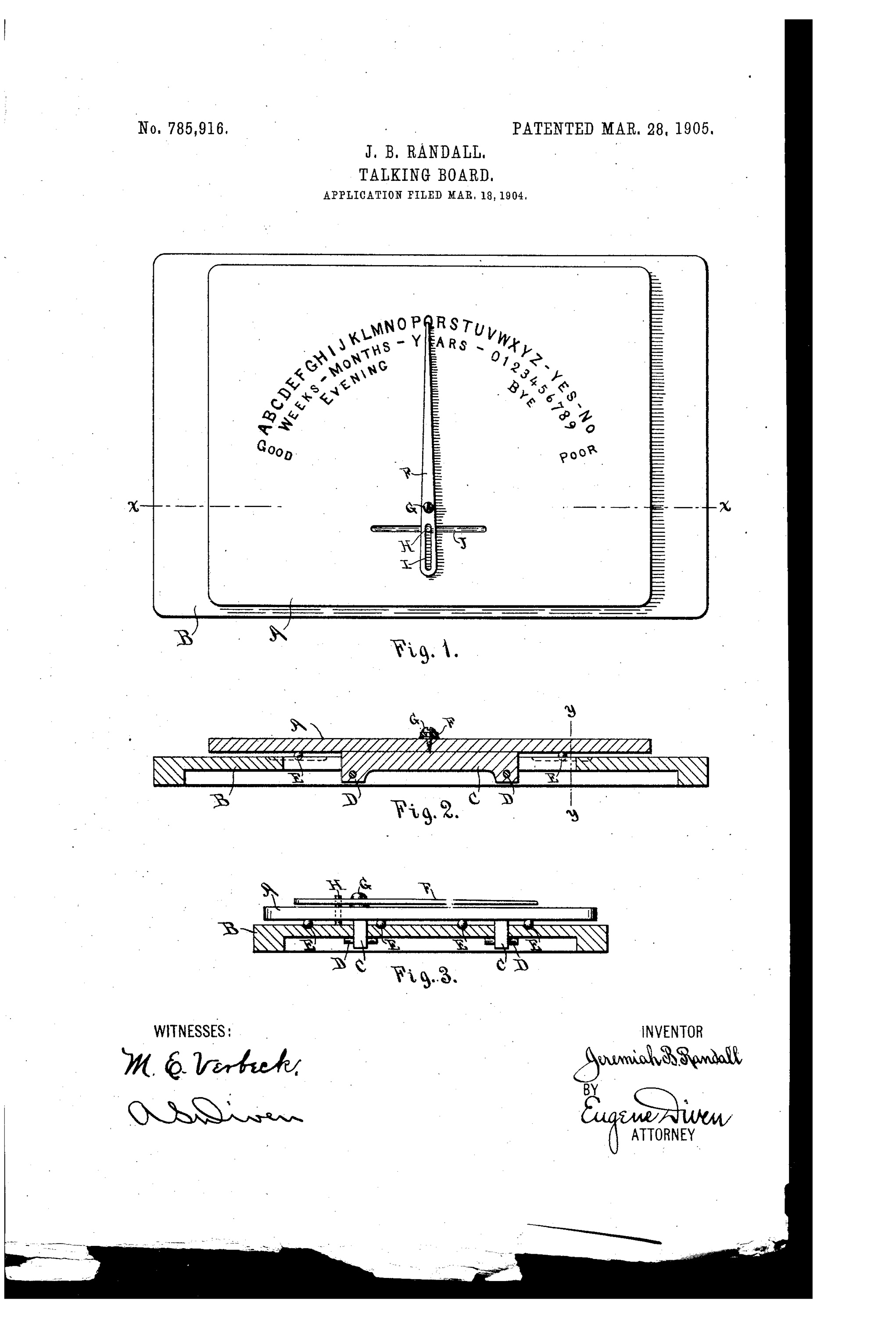
Talking-BoardUS 785,916 · Jeremiah B. Randall, Filed 18 March 1904 · granted 28 March 1905 The board moves and the pointer answers: a board lettered in concentric curves slides to and fro on ball bearings over a fixed base, and a pin in the base swings a pointer pivoted at the centre of the curves. The full patent (PDF, 198 KB) · Google Patents
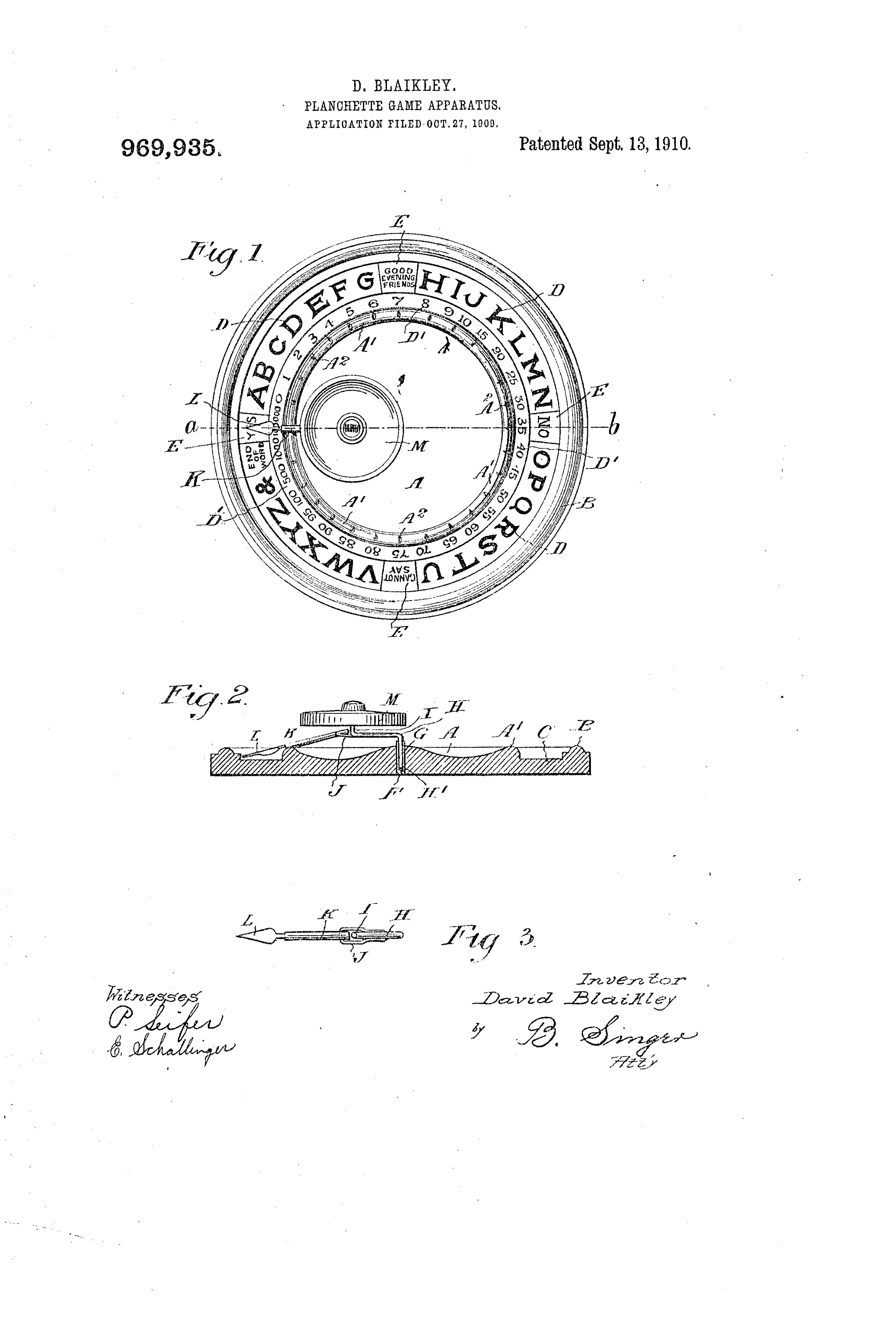
Planchette Game ApparatusUS 969,935 · David Blaikley, Glasgow, ScotlandFiled 27 October 1909 · granted 13 September 1910 Called a planchette, built as a dial: a crank arm swings from the centre of a base, its pointer travelling over notches around a raised ridge while the hand rests on a disk on the arm. The full patent (PDF, 272 KB) · Google Patents
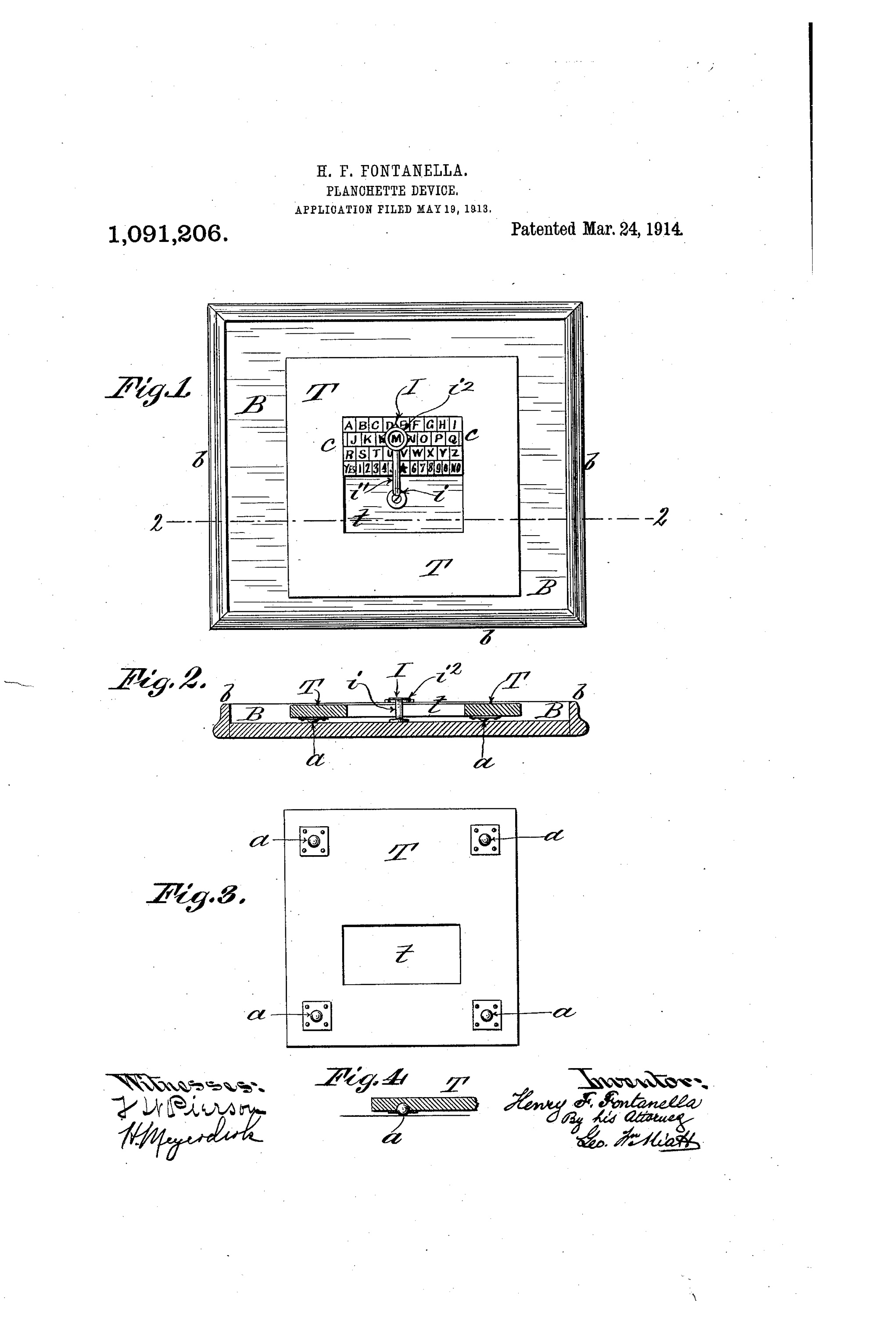
Planchette DeviceUS 1,091,206 · Henry F. Fontanella, New YorkFiled 19 May 1913 · granted 24 March 1914 A finger table printed with characters rides on balls over a base, beneath a fixed indicator: the letters move and the index stays still. The full patent (PDF, 240 KB) · Google Patents
ToyUS 1,264,637 · Stephen N. Green, Wooster, OhioFiled 23 May 1917 · granted 30 April 1918 The dial straightened into a line: a rider with sliding feet runs beneath a raised platform, held by hand-rests at its ends, and a standard rising through a central slot carries the indicator along rows of characters. The full patent (PDF, 183 KB) · Google Patents
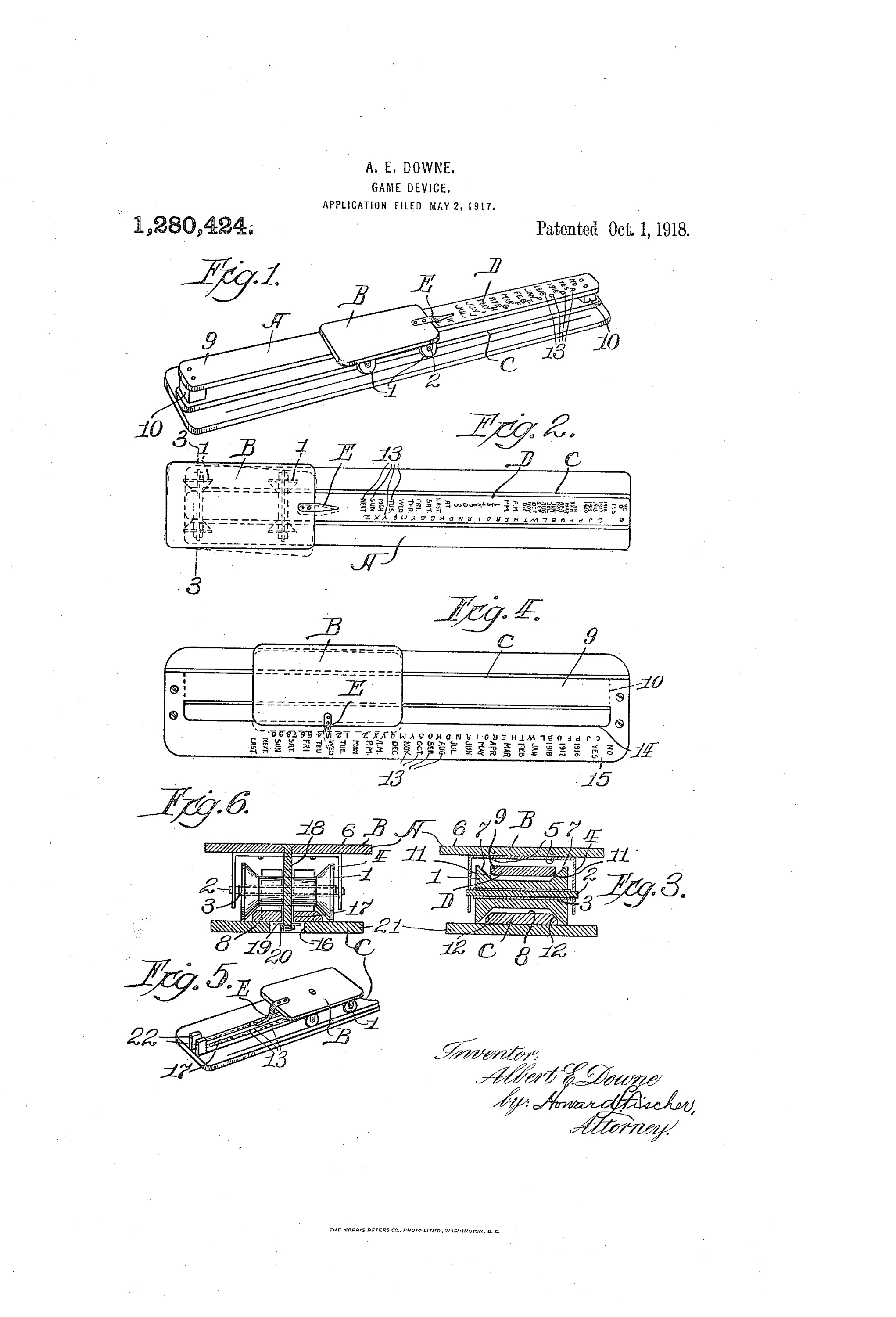
Game DeviceUS 1,280,424 · Albert E. Downe, St. Paul, MinnesotaFiled 2 May 1917 · granted 1 October 1918 A little table on spool-shaped wheels runs on a track with a guide strip between the flanges; a bar over the track keeps it down, and its finger points to the characters printed along the bar. The full patent (PDF, 568 KB) · Google Patents
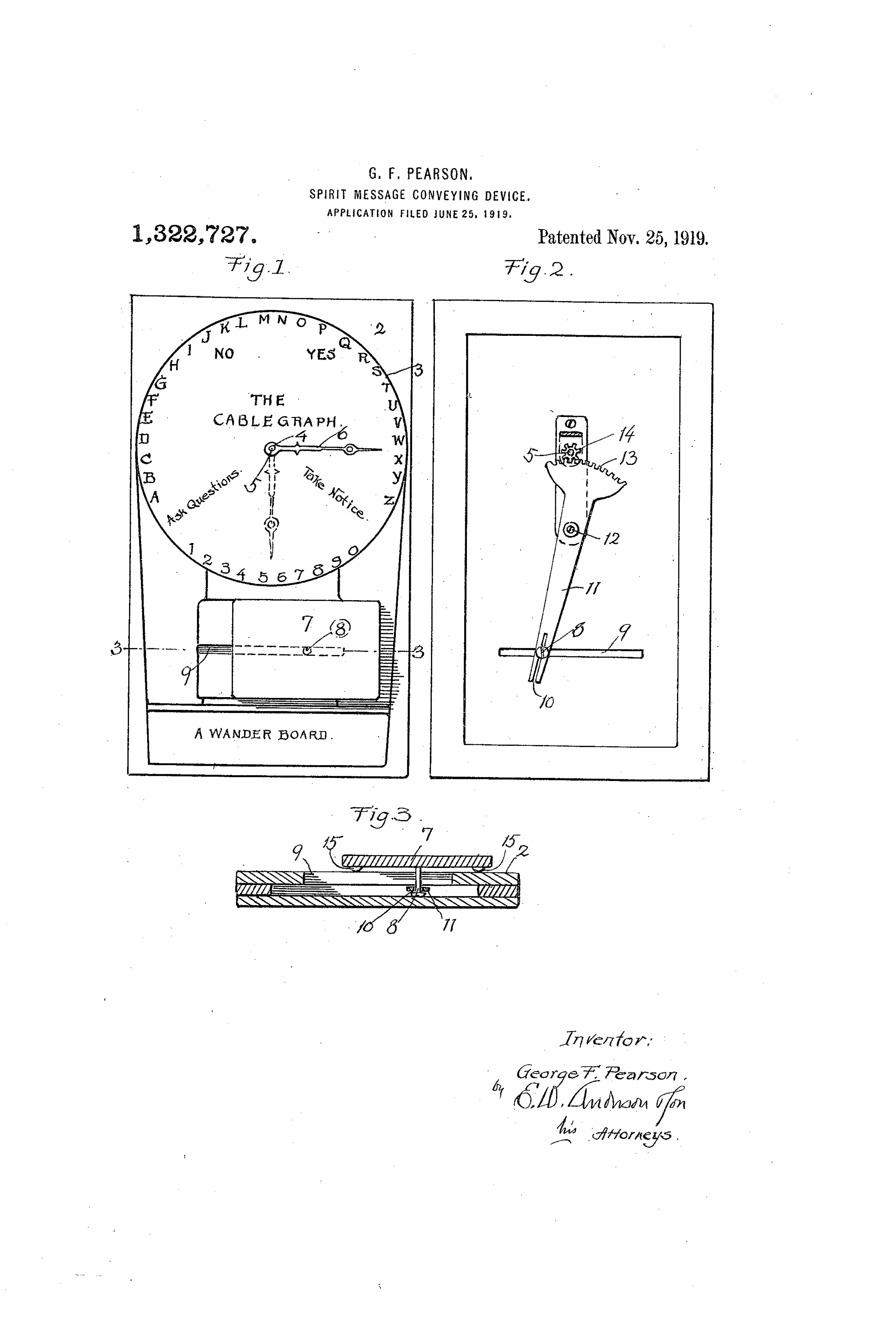
Spirit-Message-Conveying DeviceUS 1,322,727 · George F. Pearson, Lowell, MassachusettsFiled 25 June 1915 · granted 25 November 1919 A dial of letters, digits, No and Yes, and the instructions Take notice and Ask questions. A small key, moved by the hand through a slot in the board, rocks a pivoted lever whose toothed segment turns a pinion on the pointer's shaft. The drawing names the dial The Cablegraph, and the board A Wander Board. The full patent (PDF, 189 KB) · Google Patents
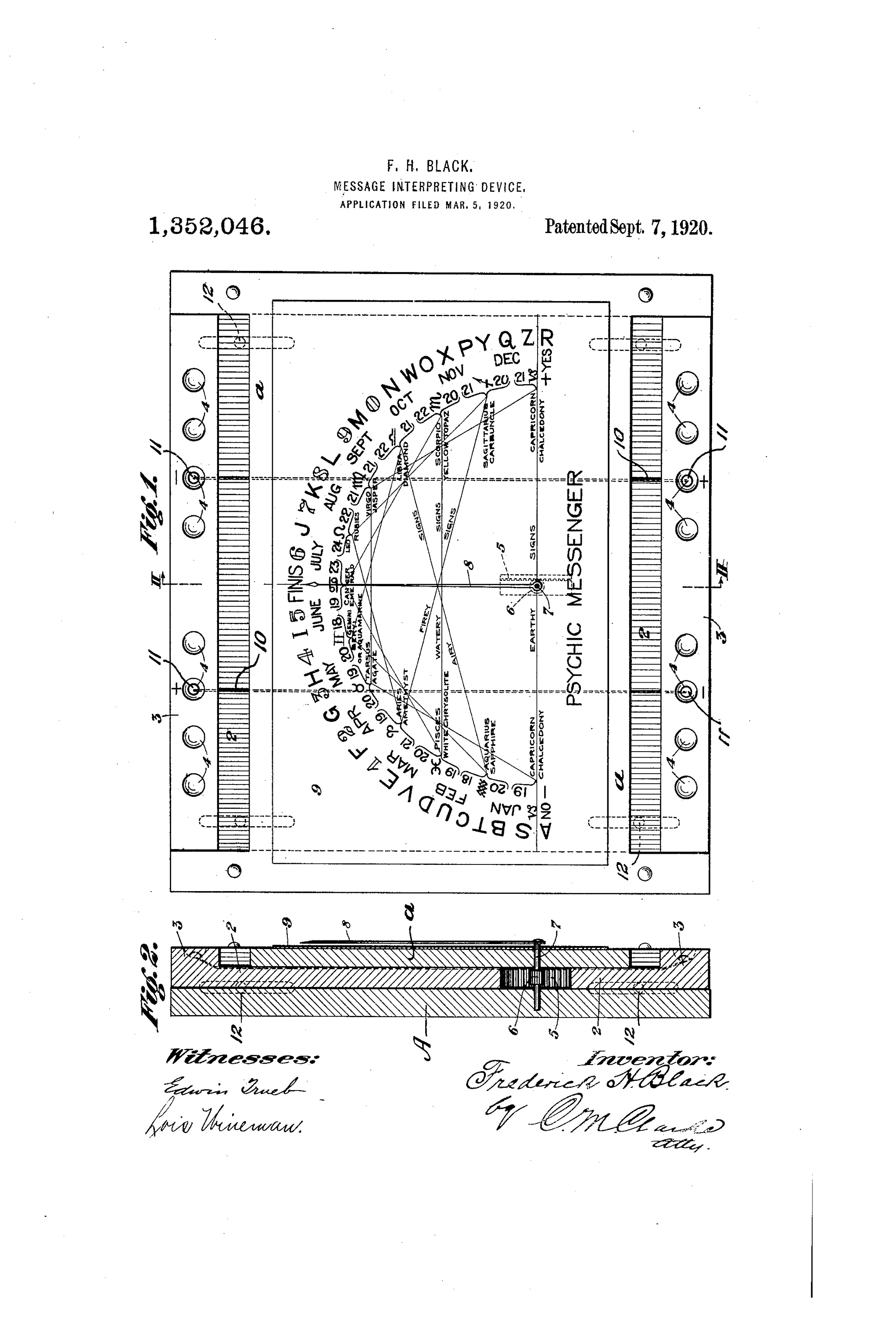
Message-Interpreting DeviceUS 1,352,046 · Frederick H. Black, Pittsburgh, PennsylvaniaFiled 5 March 1920 · granted 7 September 1920 A pointer pivoted beneath a dial of letters, numerals, the months, the signs of the zodiac and the names of gemstones. A board sliding between base and bridge carries a rack that meshes with a pinion on the pointer's stem, so that moving the board left or right swings the pointer. The full patent (PDF, 355 KB) · Google Patents
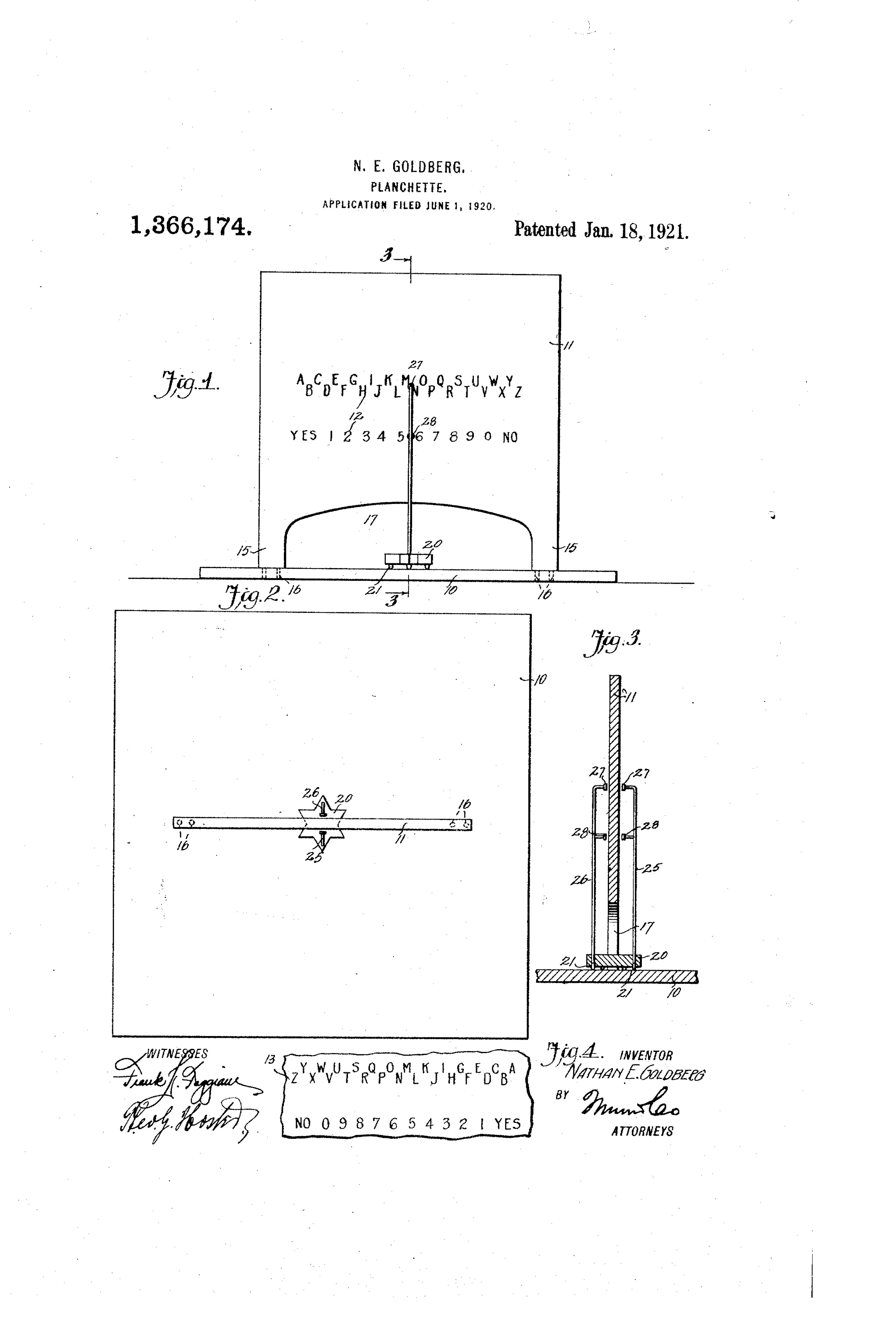
PlanchetteUS 1,366,174 · Nathan E. Goldberg, New YorkFiled 1 June 1920 · granted 18 January 1921 A star-shaped table on a base, with two pointers that indicate letters, digits, Yes and No on an upright board. The full patent (PDF, 368 KB) · Google Patents
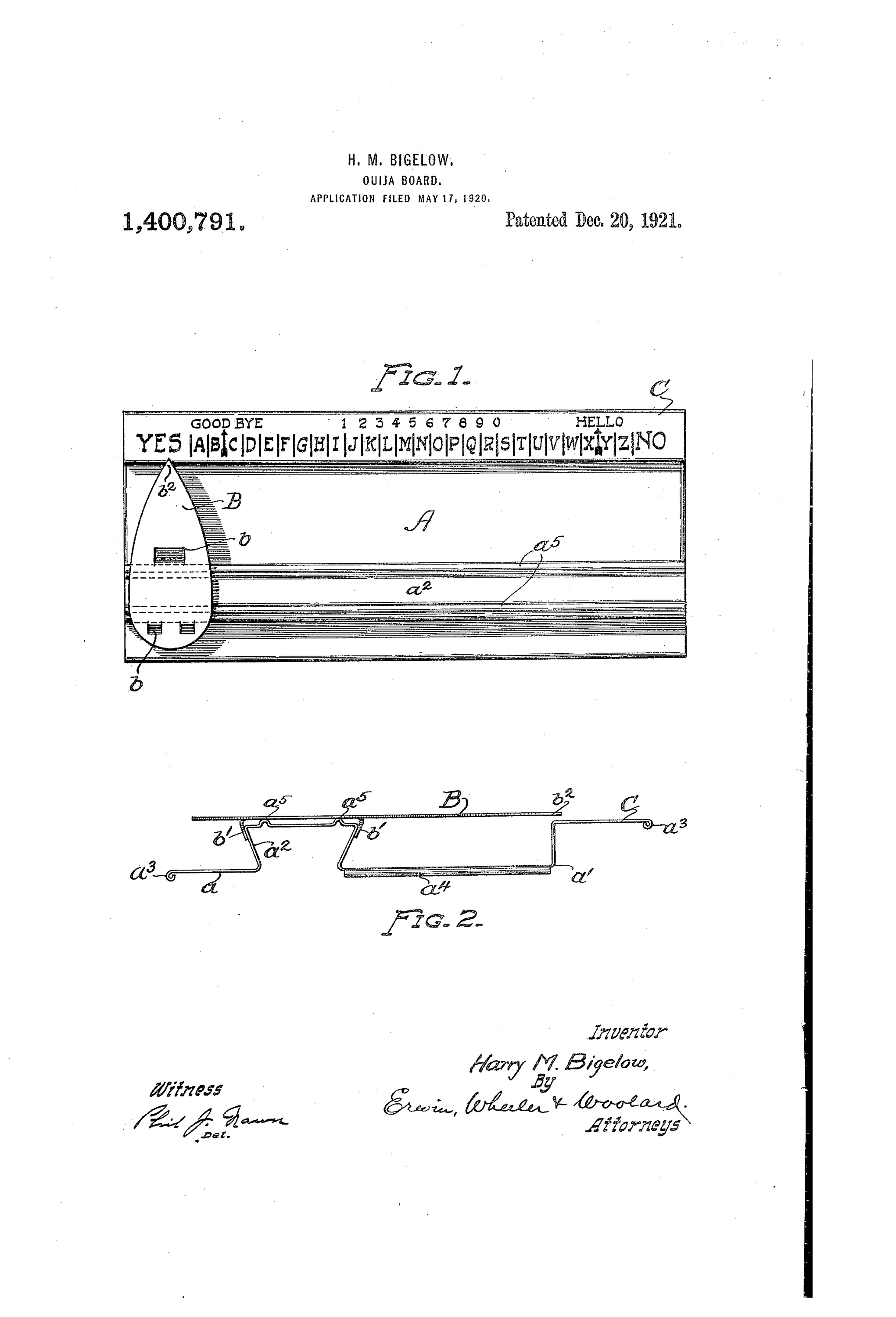
Ouija-BoardUS 1,400,791 · Harry M. Bigelow, Milwaukee, WisconsinFiled 17 May 1920 · granted 20 December 1921 A bent metal plate with a dovetail rail along its centre; an index piece rides the rail on raised beads that cut the friction and the wobble, its point stopping at the symbols ranged behind. The full patent (PDF, 314 KB) · Google Patents
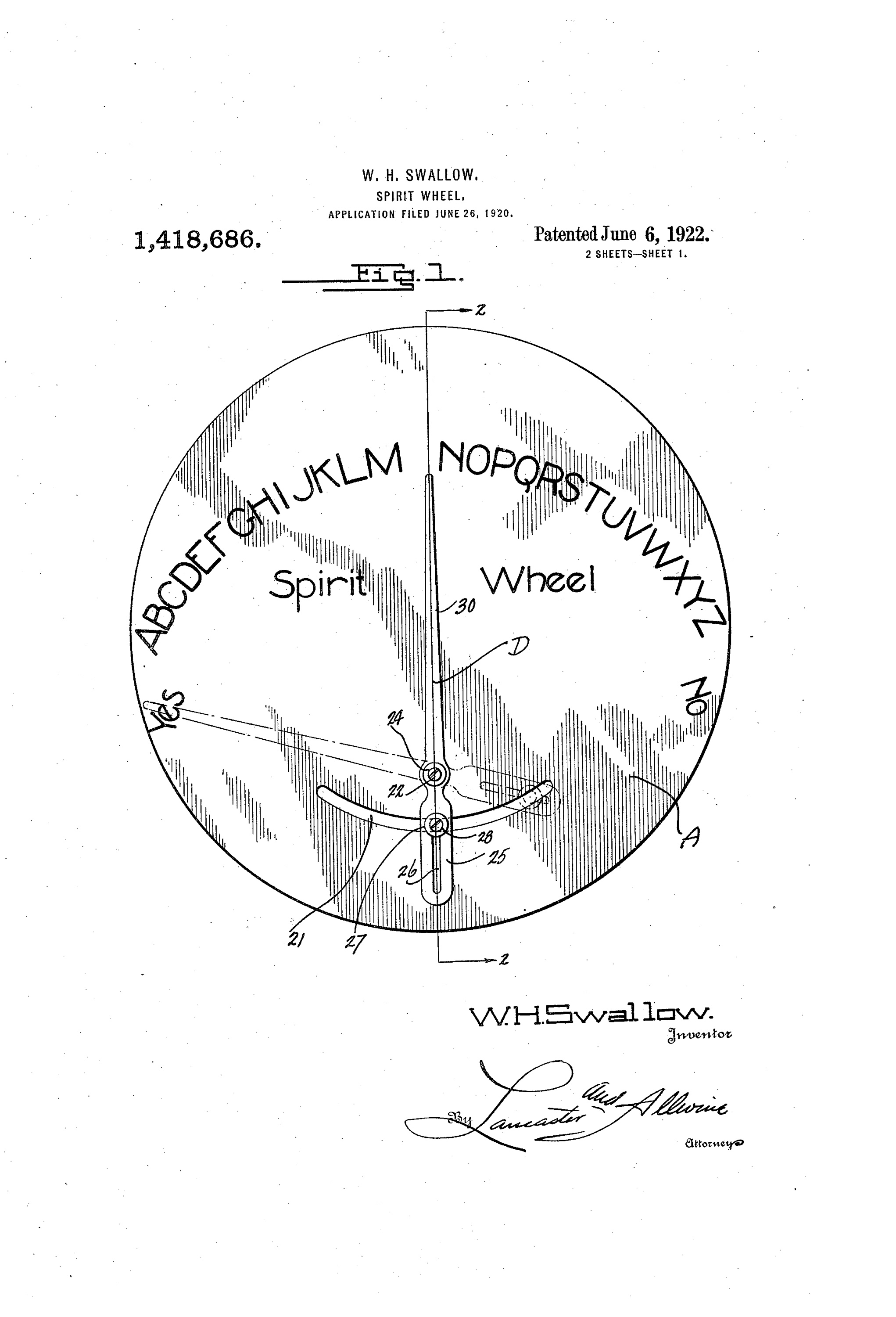
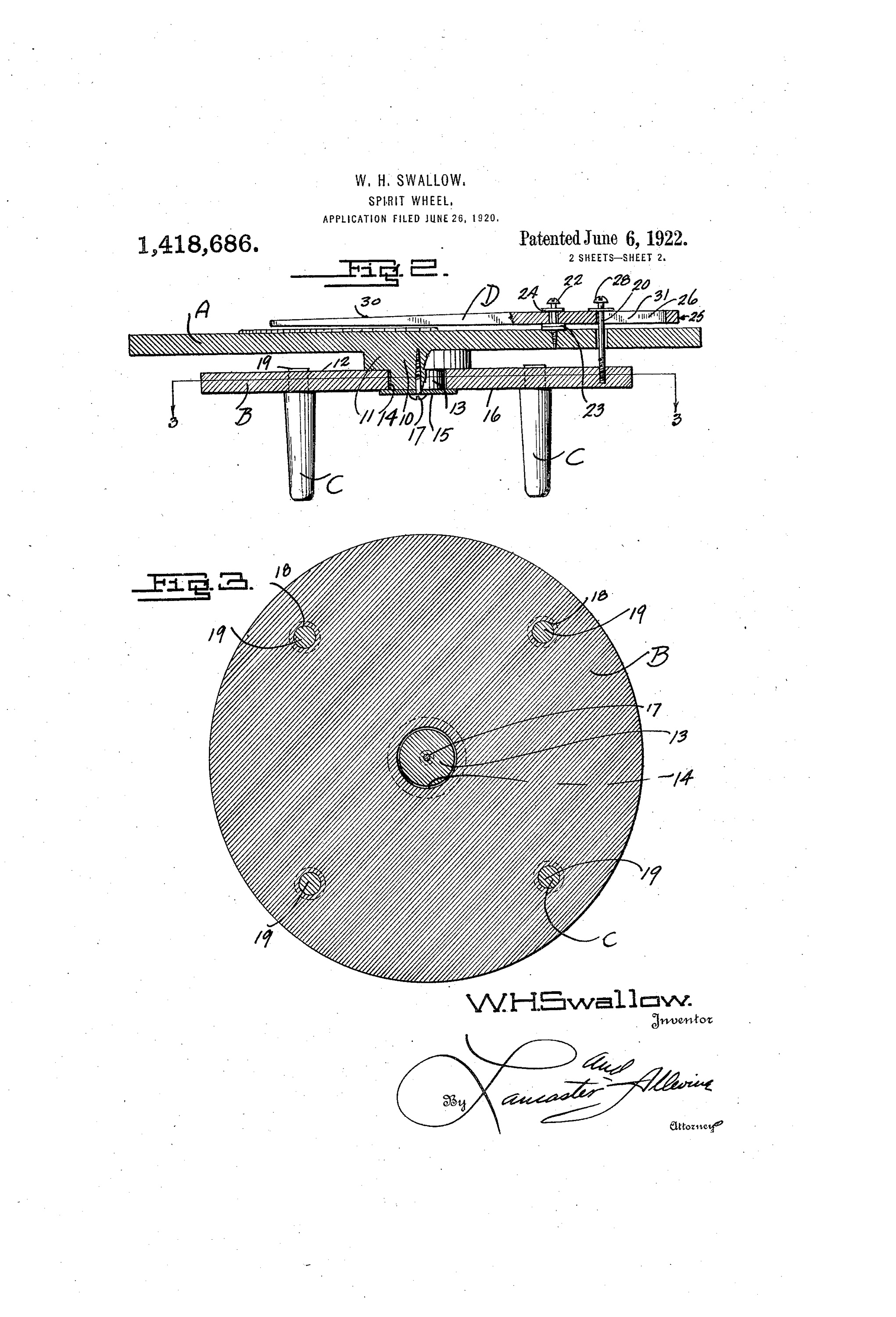
Spirit WheelUS 1,418,686 · William H. Swallow, Johnstown, PennsylvaniaFiled 26 June 1920 · granted 6 June 1922 A lettered wheel pivots on a base. An arm pivoted on the wheel has a slotted end that engages a fixed post rising through a slot in the wheel, so that when the fingers resting on the wheel turn it, the post swings the pointer across a curved row of letters, with Yes and No at its two ends. The full patent (PDF, 462 KB) · Google Patents
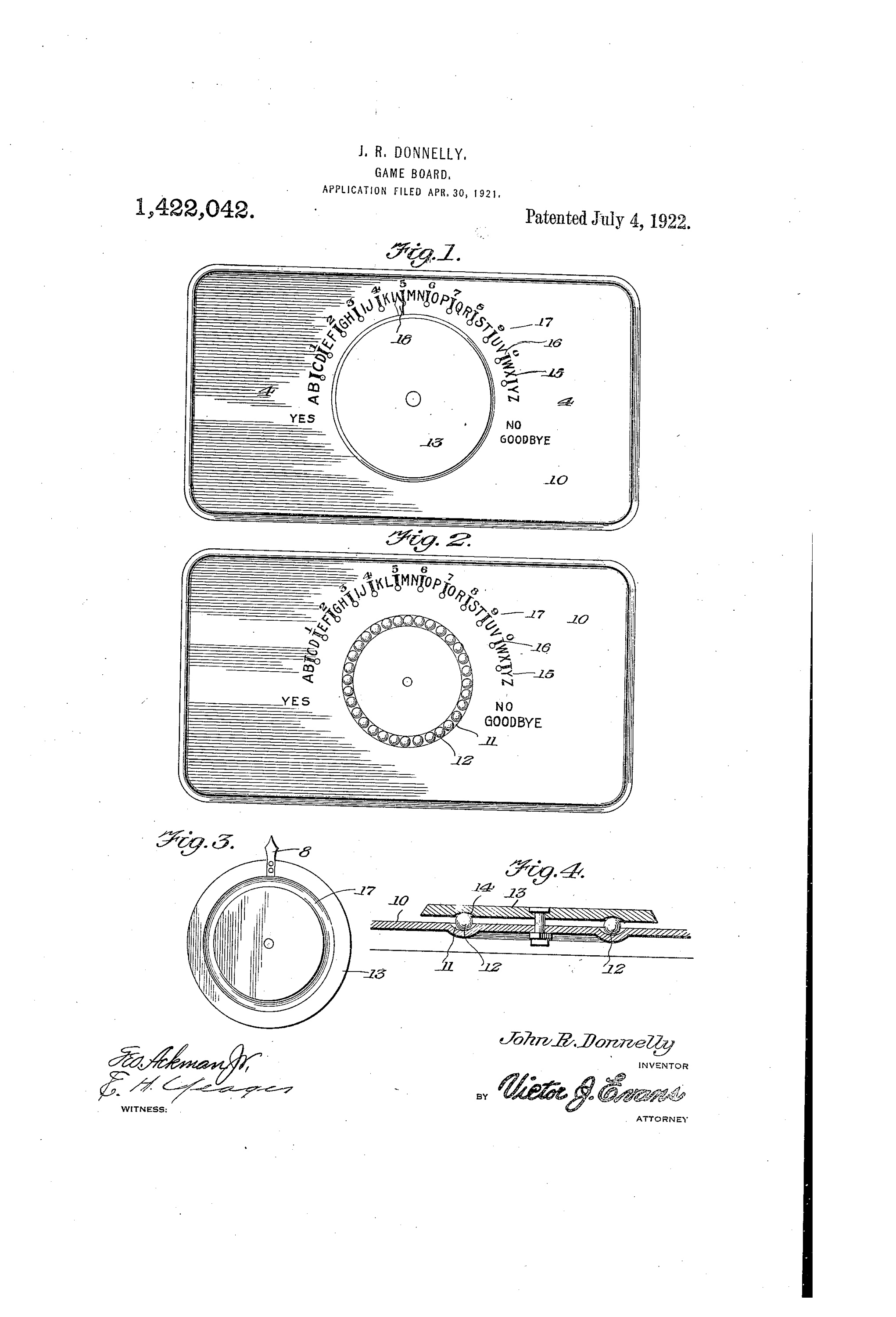
Game BoardUS 1,422,042 · John R. Donnelly, Fairfield, MaineFiled 30 April 1921 · granted 4 July 1922 Hare's disk at its simplest: a rotary member sitting on ball bearings in a circular groove, so that it turns at the lightest touch of the fingers, with a pointer at its edge over the letters. The full patent (PDF, 190 KB) · Google Patents
Psychic InstrumentUS 1,476,158 · Grover C. Haffner, Los Angeles, CaliforniaFiled 26 November 1921 · granted 4 December 1923 A lettered and numbered board on a rounded-leg base, so that it tilts. A cord and pulley anchored to the base turn the pointer's shaft as the table tilts, and an elastic cord draws the pointer home when the table comes level: Hare's tilting table, made small. The full patent (PDF, 363 KB) · Google Patents
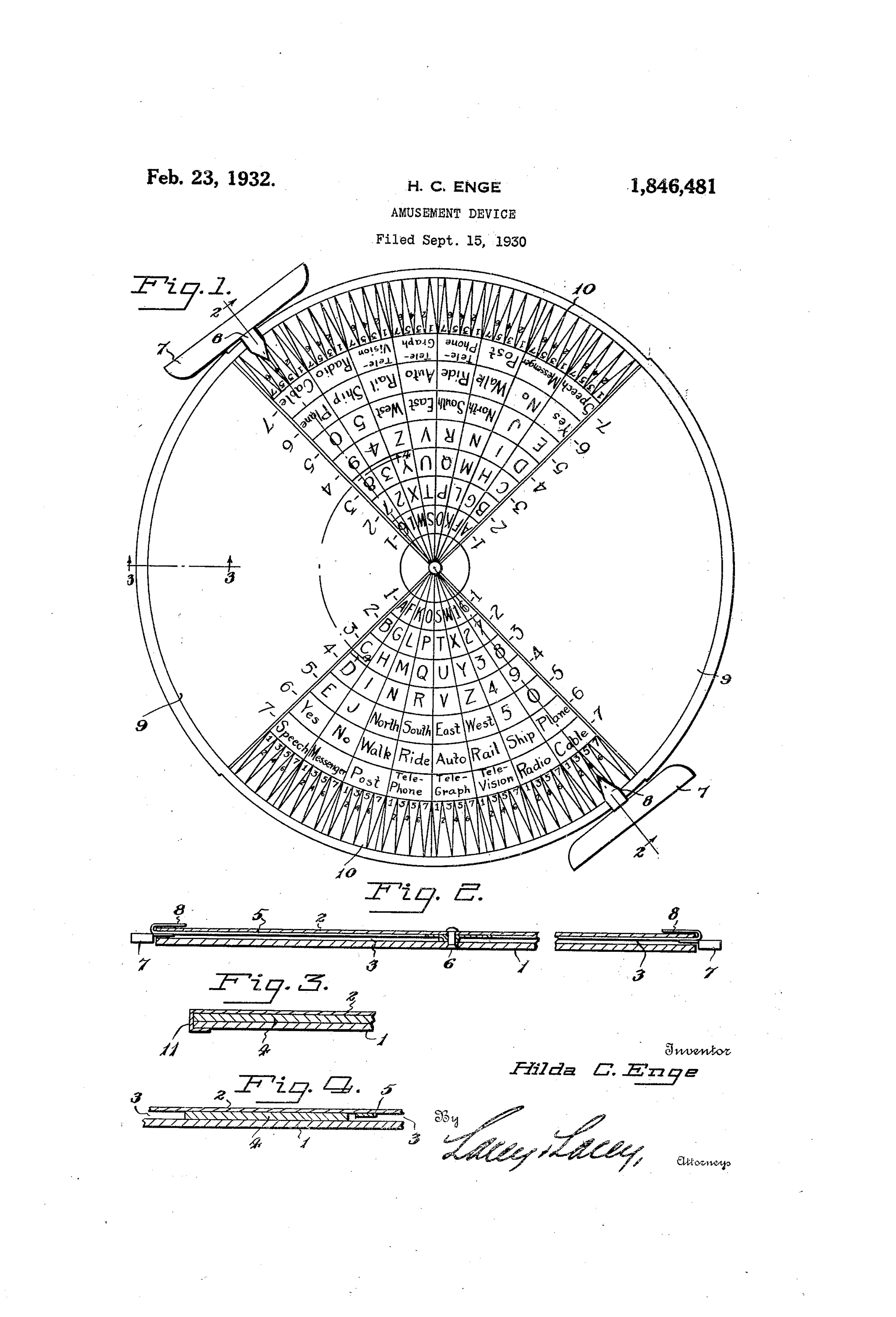
Amusement DeviceUS 1,846,481 · Hilda C. Enge, Albuquerque, New MexicoFiled 15 September 1930 · granted 23 February 1932 A flat pivoted bar between a base and a top, with pointers over the face and a finger rest at each end; the players' fingertips swing it to a radial row of characters, and a numbered space names the circle. The full patent (PDF, 344 KB) · Google Patents
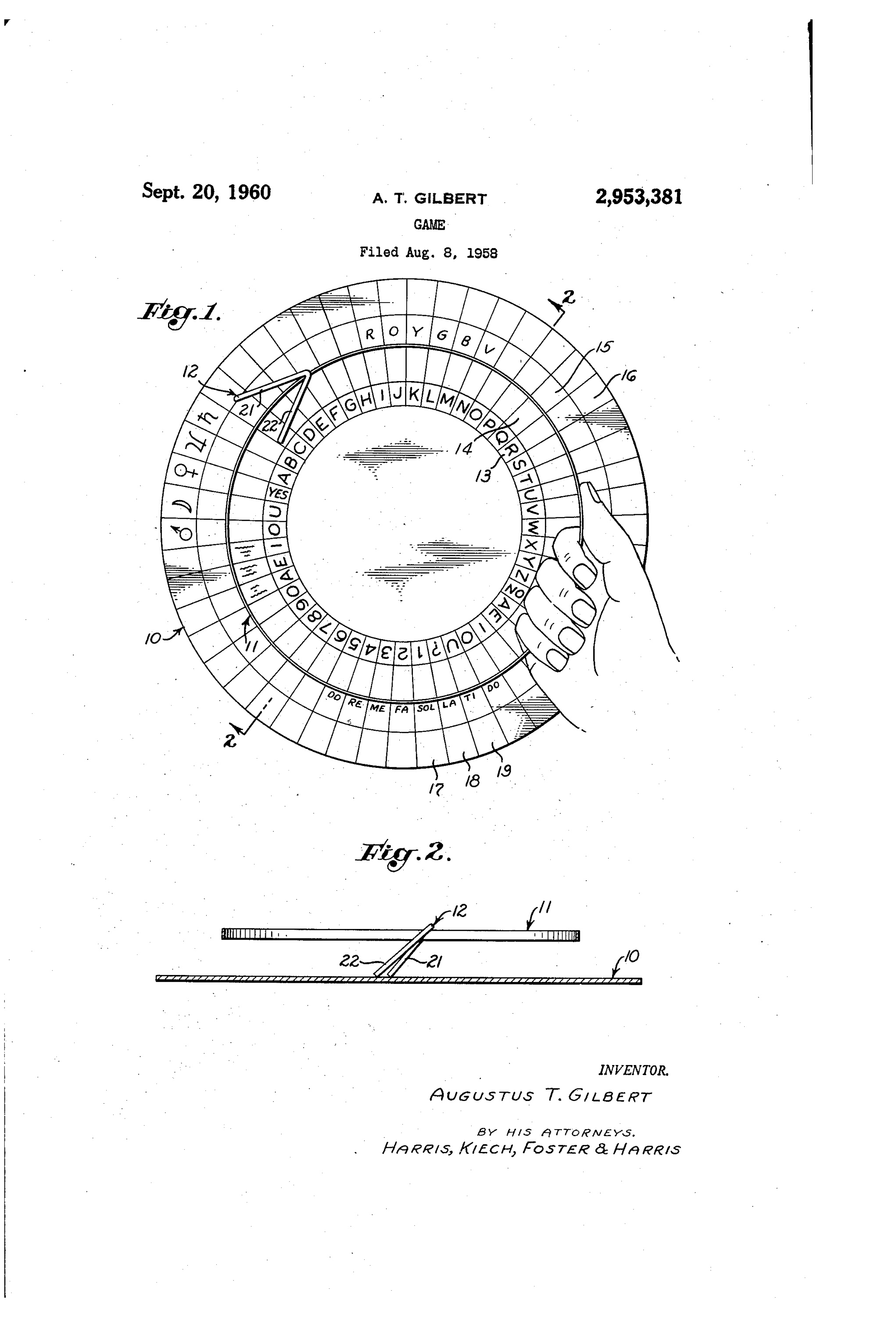
GameUS 2,953,381 · Augustus T. Gilbert, Long Beach, CaliforniaFiled 8 August 1958 · granted 20 September 1960 The one patent that names its motor plainly: a V-shaped pointer rests its legs on bands of characters and its apex on a resilient ring held in the player's hand, and the tremor of the hand walks it round the board. The full patent (PDF, 283 KB) · Google Patents
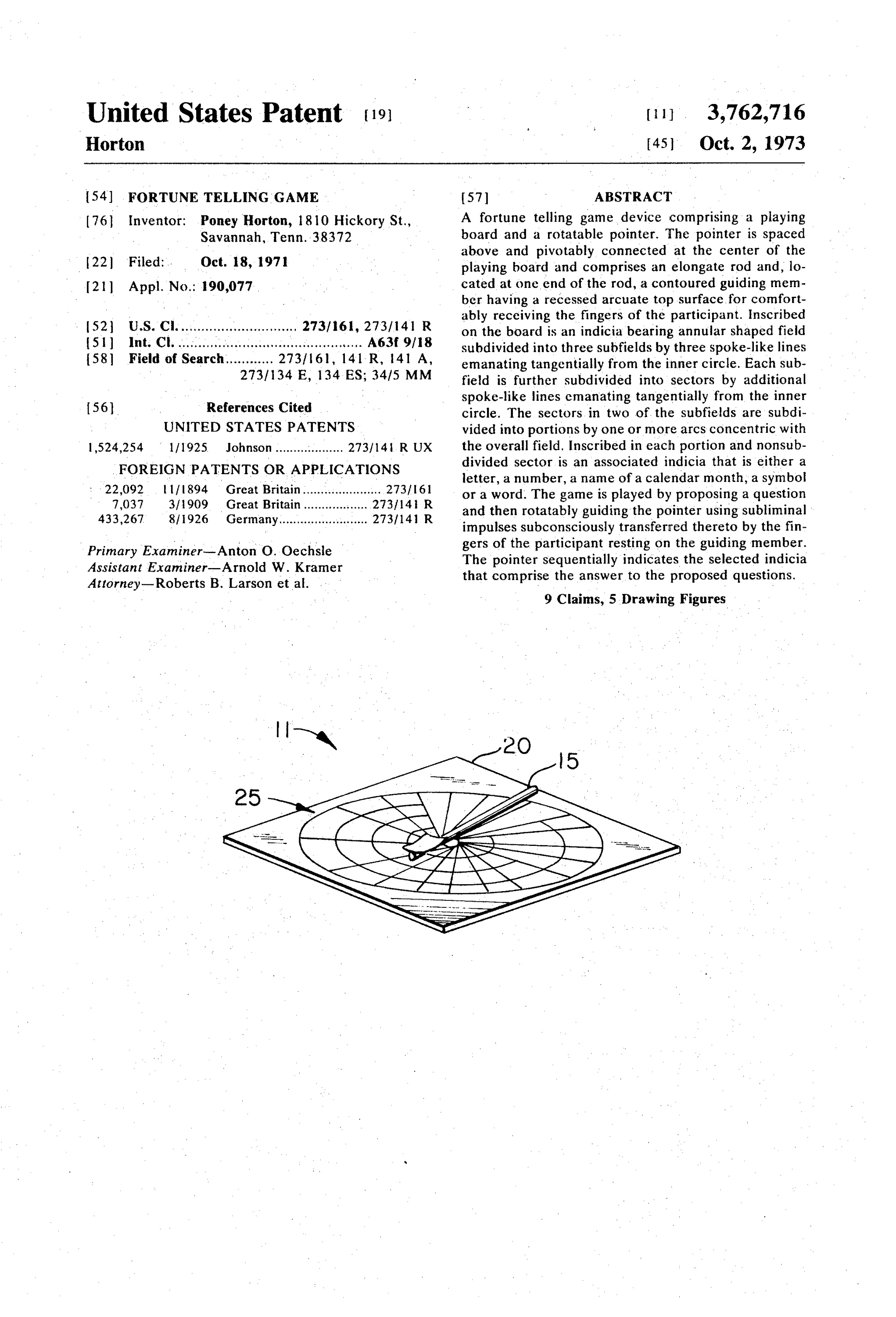
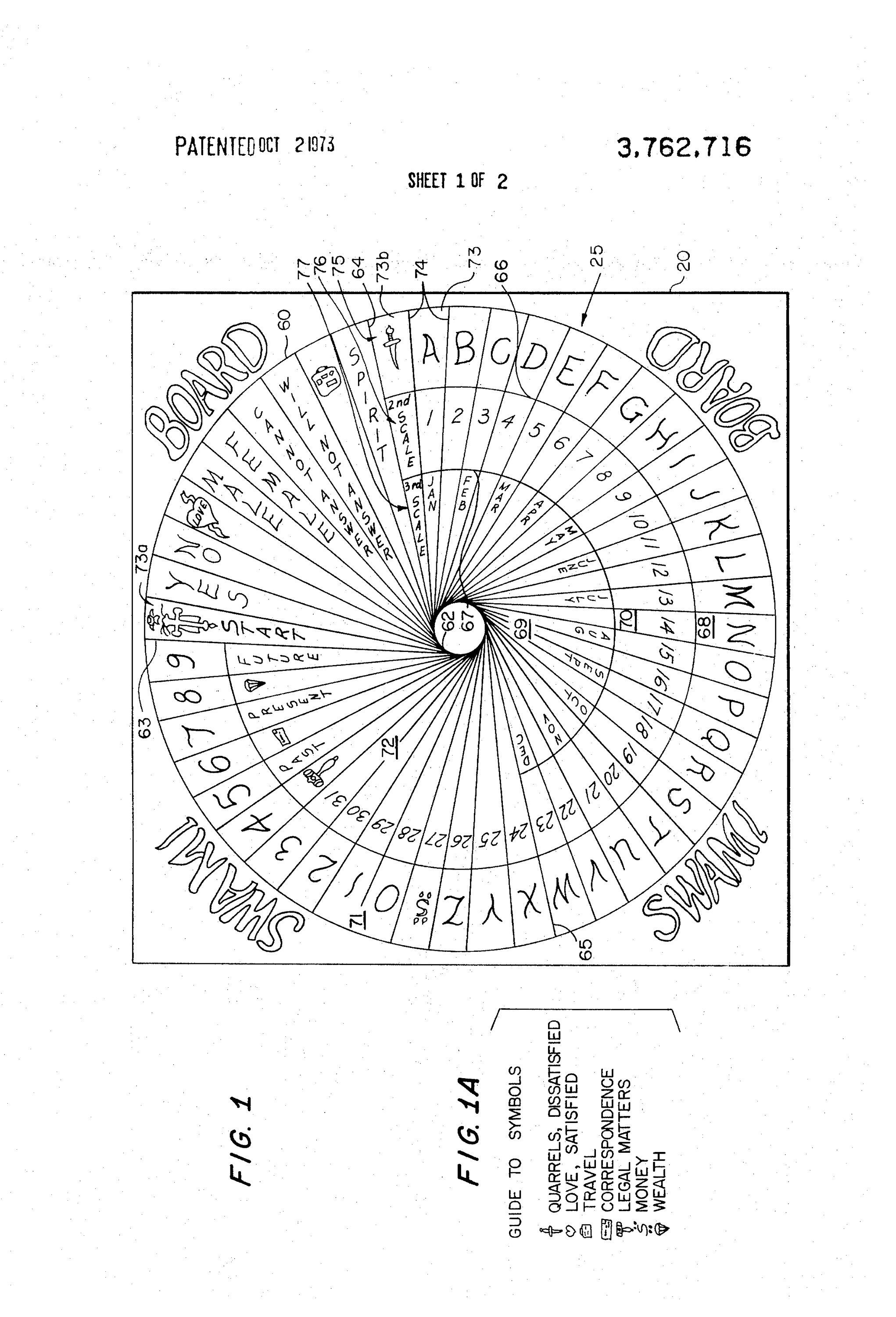
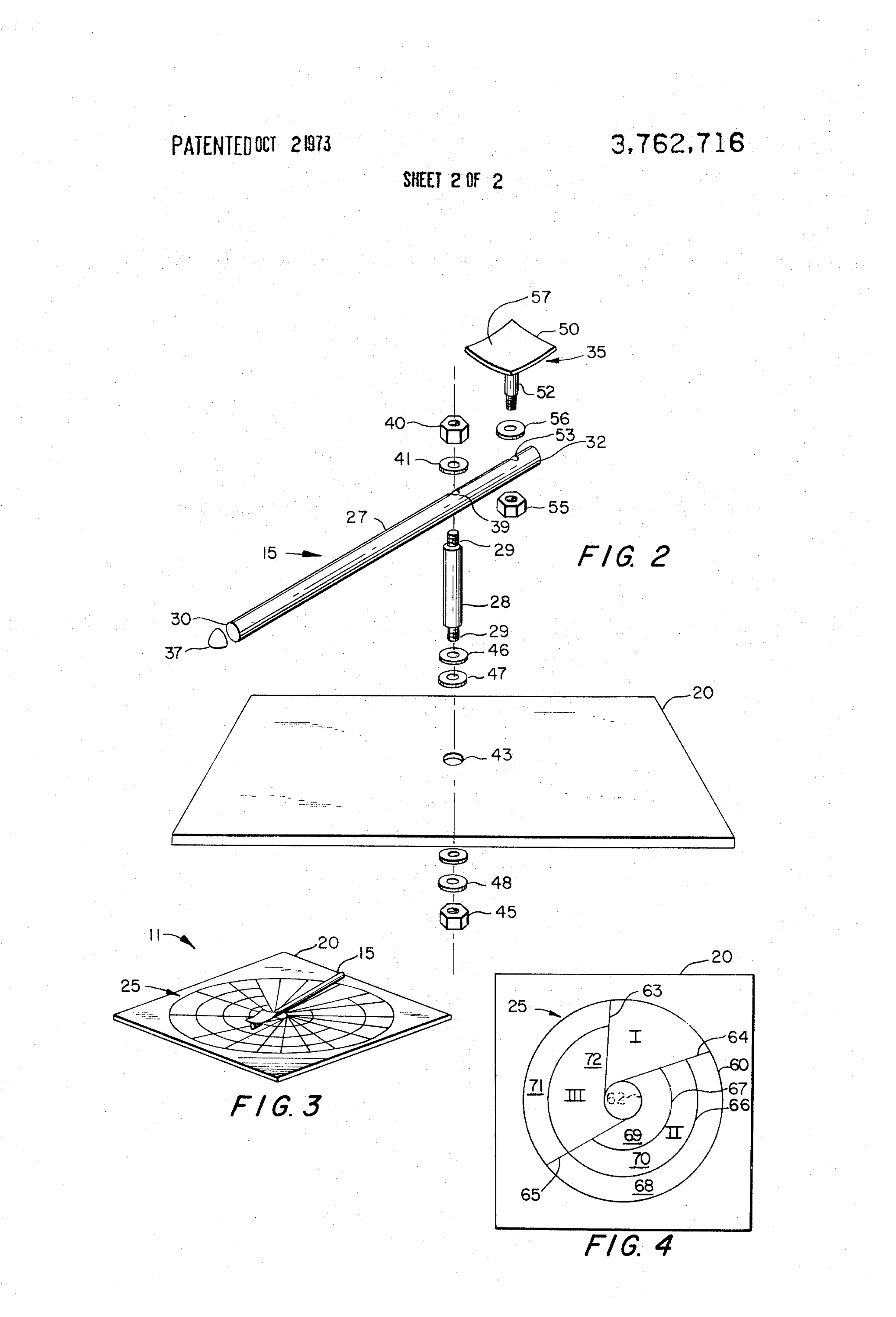
Fortune Telling GameUS 3,762,716 · Poney Horton, Savannah, TennesseeFiled 18 October 1971 · granted 2 October 1973 A rod pointer pivoted at the centre of the board and held above it on a shaft, with a concave top at one end for the fingers to rest in and guide it round. The full patent (PDF, 663 KB) · Google Patents
III.Of the Same Family
Not all dials, but all instruments for the same question: the planchette of 1868, a talking board that admits involuntary motion, telepathy, electricity, a typewriter and a bell.
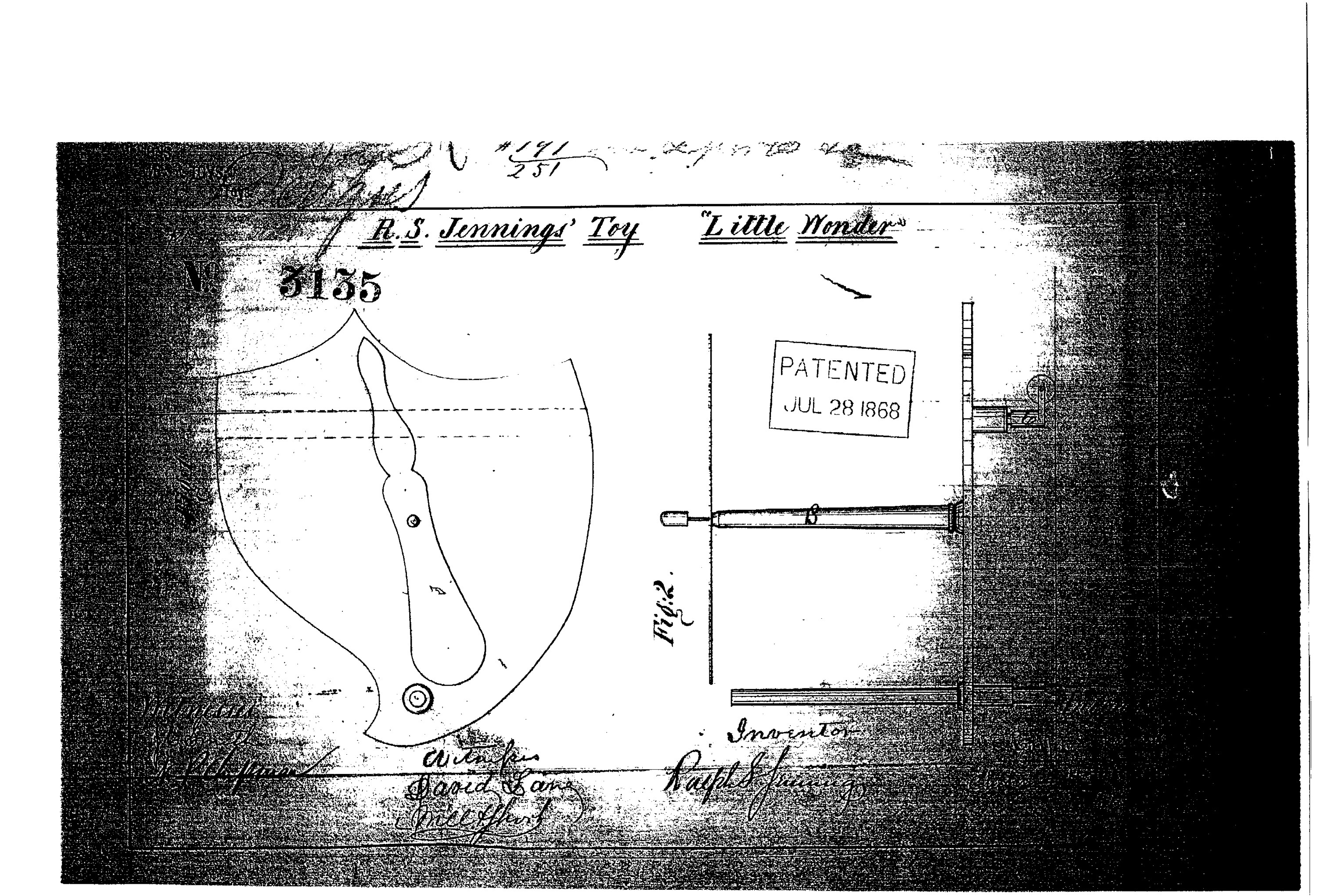
Design for a Toy (the Planchette)US Design 3,135 · Ralph S. Jennings, New YorkGranted 28 July 1868 The writing planchette of the first great craze, protected as a design: the shape of the board and the standard and castors beneath it. The sheet is endorsed by hand: R. S. Jennings' Toy, Little Wonder. The full patent (PDF, 301 KB) · Google Patents
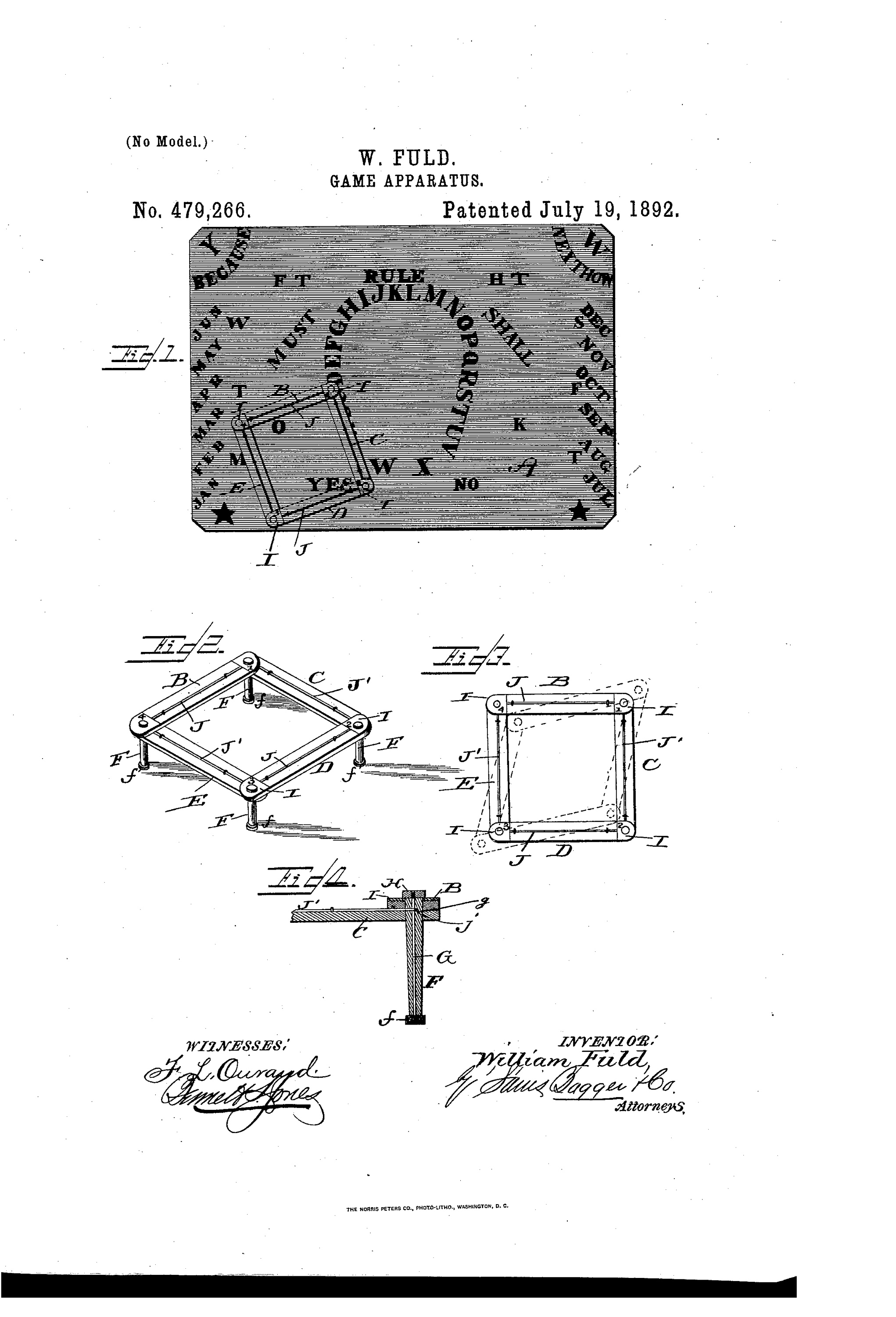
Game ApparatusUS 479,266 · William Fuld, Baltimore, MarylandFiled 28 March 1892 · granted 19 July 1892 A talking-board patent, included here for one sentence: the frame, it says, will commence to move across the table “by the involuntary muscular motion of the hands of the players, or through some other agency.” The question, in the inventor's own words, left open. The full patent (PDF, 380 KB) · Google Patents
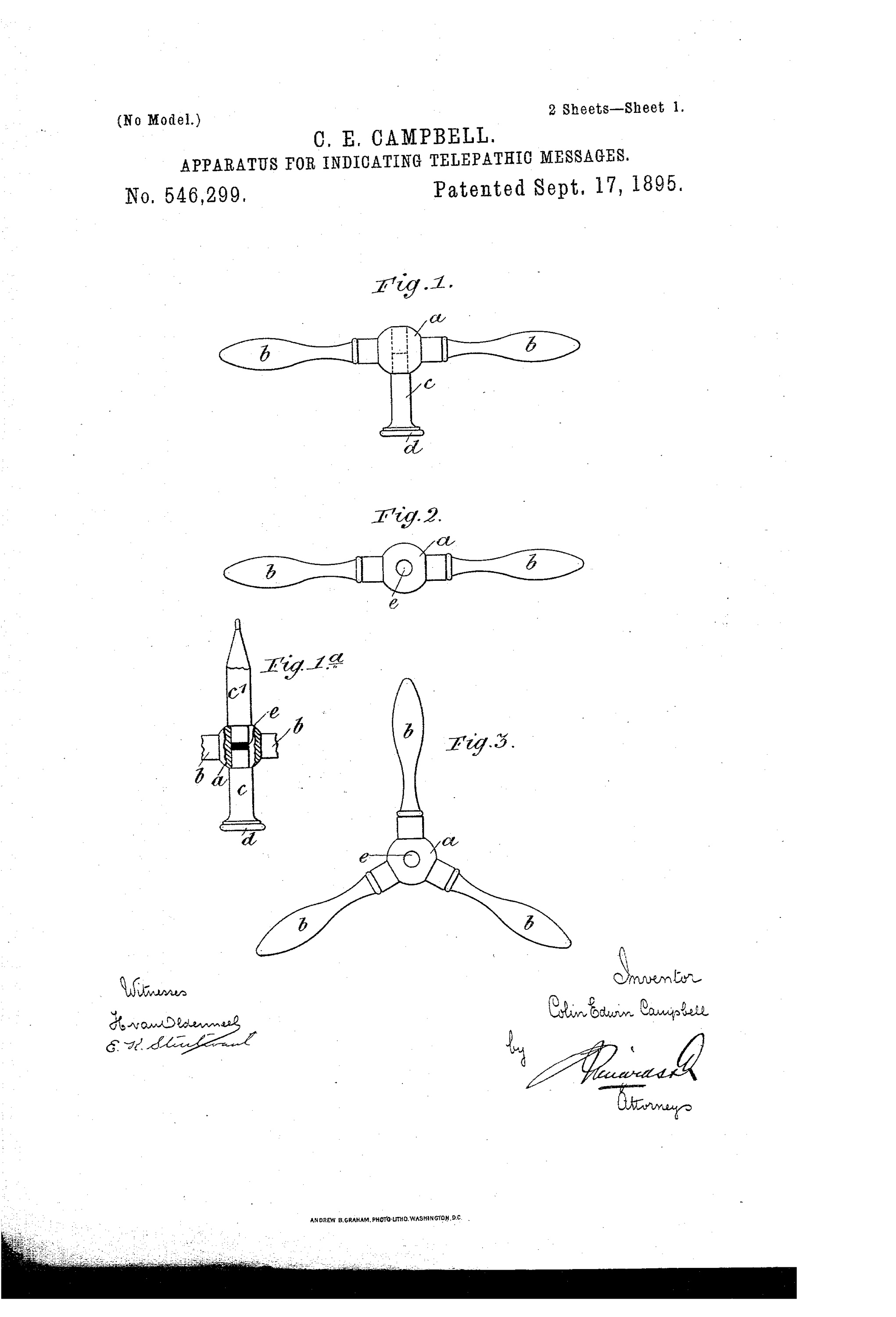
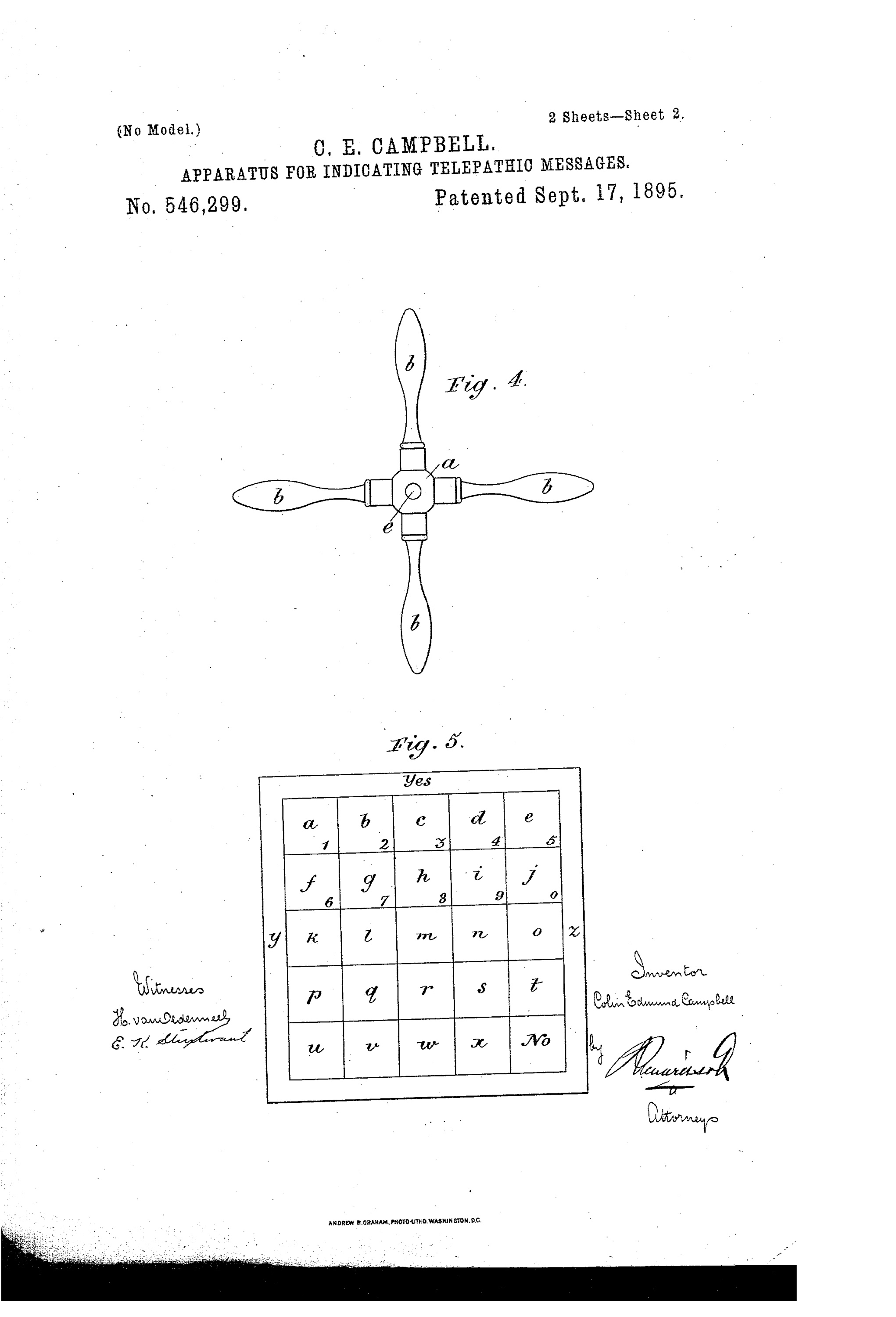
Apparatus for Indicating Telepathic MessagesUS 546,299 · Colin Edmund Campbell, London, EnglandGranted 17 September 1895 Not a dial: a boss with radiating handles and a smooth foot that travels over a lettered chart, or carries a pencil over plain paper. The vocabulary has moved from spirits to telepathy. The full patent (PDF, 245 KB) · Google Patents
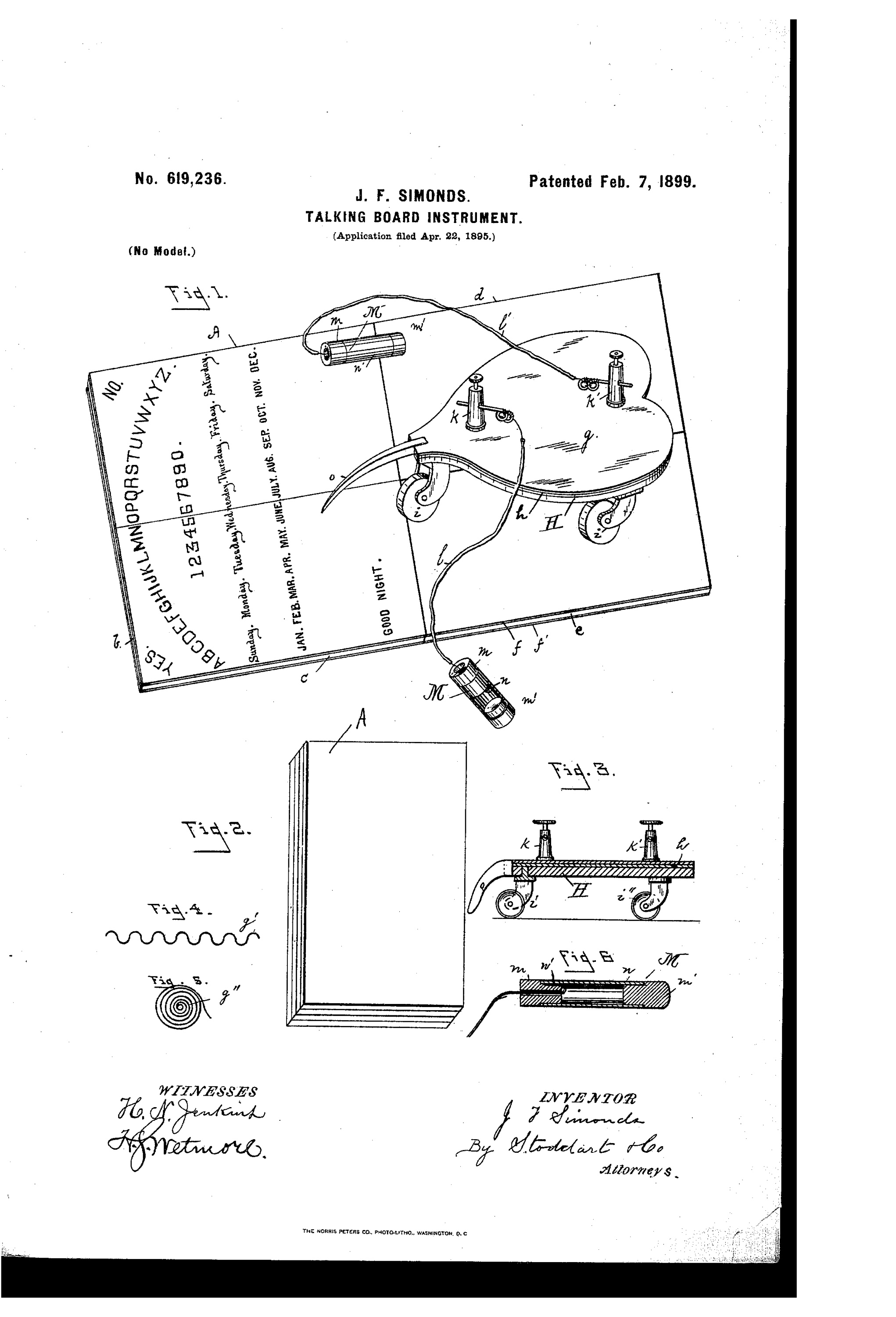
Talking-Board InstrumentUS 619,236 · Justin F. Simonds, Washington, District of ColumbiaFiled 22 April 1895 · granted 7 February 1899 A heart-shaped carriage on three castors with a pointer at its front edge, and a copper plate insulated from its top and wired to two metal handles held by the sitters: electricity invoked, and nothing said of what it does. The full patent (PDF, 255 KB) · Google Patents
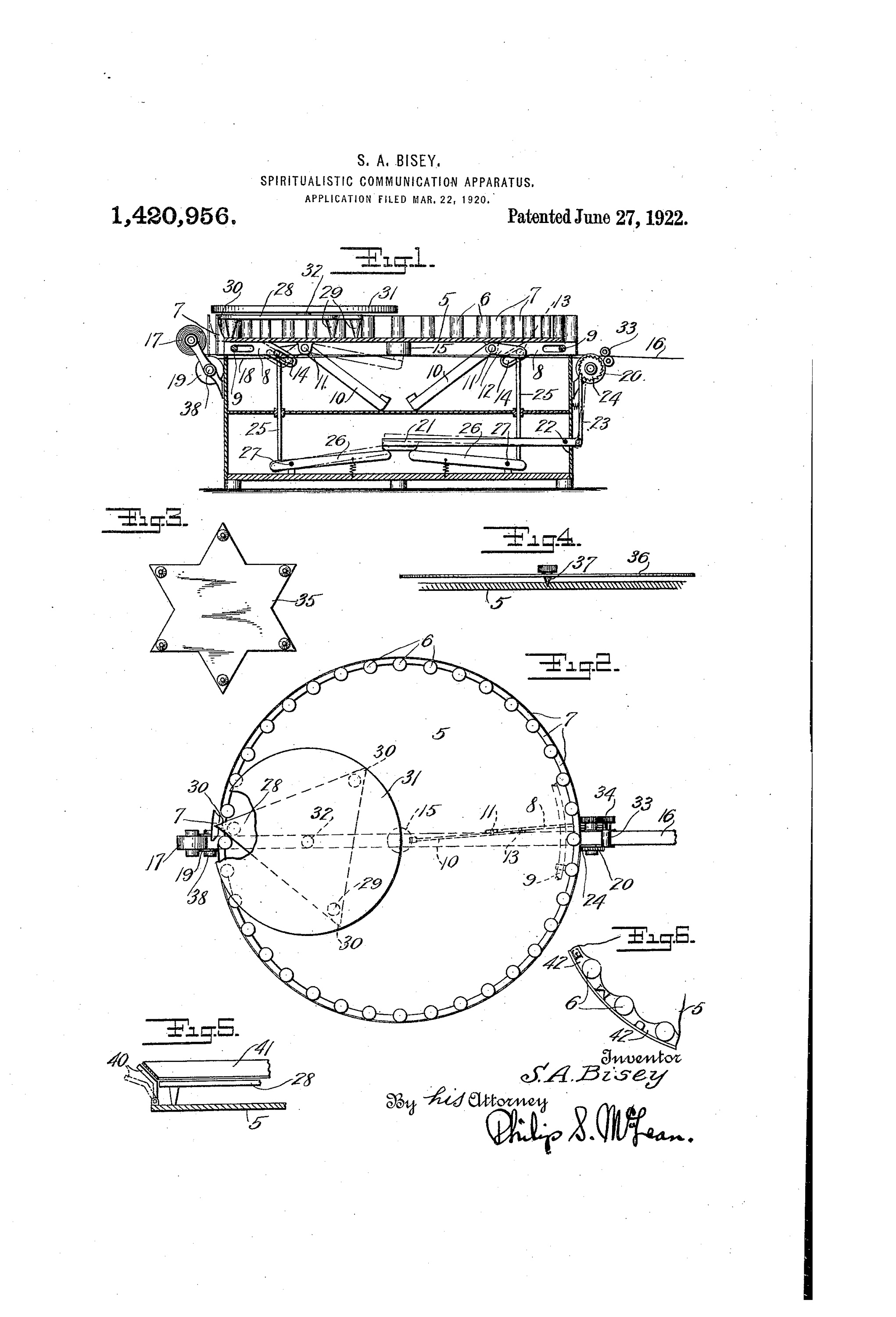
Spiritualistic Communication ApparatusUS 1,420,956 · Sunker Abaji Bisey, New YorkFiled 22 March 1920 · granted 27 June 1922 The spirit typewriter. A planchette, triangular or six-pointed, presses into pockets around the rim of a table; each pocket drives a slide and a type bar, which strikes a central platen and prints the letter onto a paper tape that a universal bar advances. The full patent (PDF, 430 KB) · Google Patents
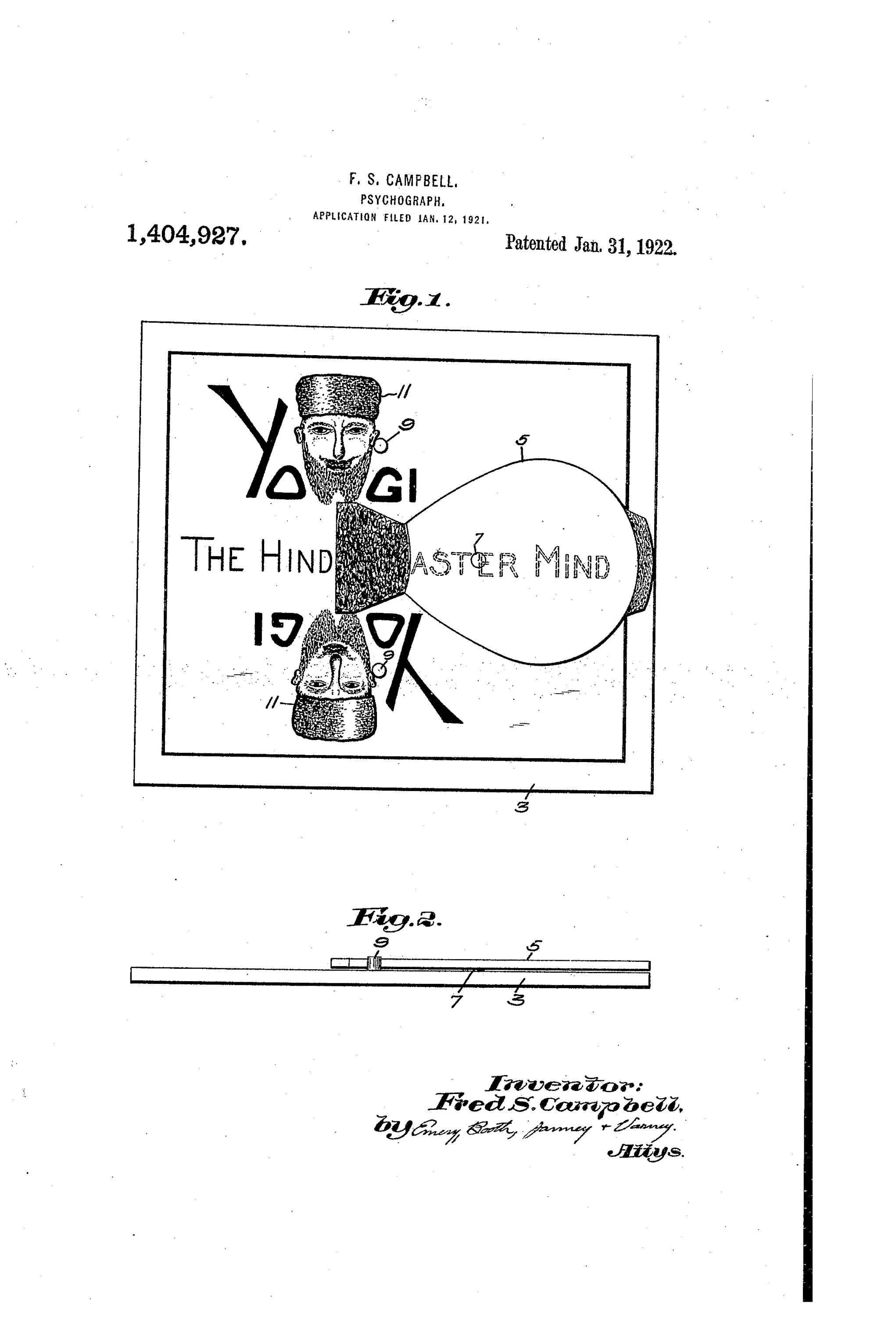
PsychographUS 1,404,927 · Fred S. Campbell, Lynn, MassachusettsFiled 12 January 1921 · granted 31 January 1922 A planchette shaped like an incense burner, swivelled on its base so that it swings in a short arc and raps against one of two posts: the séance-table knock, built into the instrument. The drawing names it Yogi, the Hindu Master Mind. The full patent (PDF, 265 KB) · Google Patents
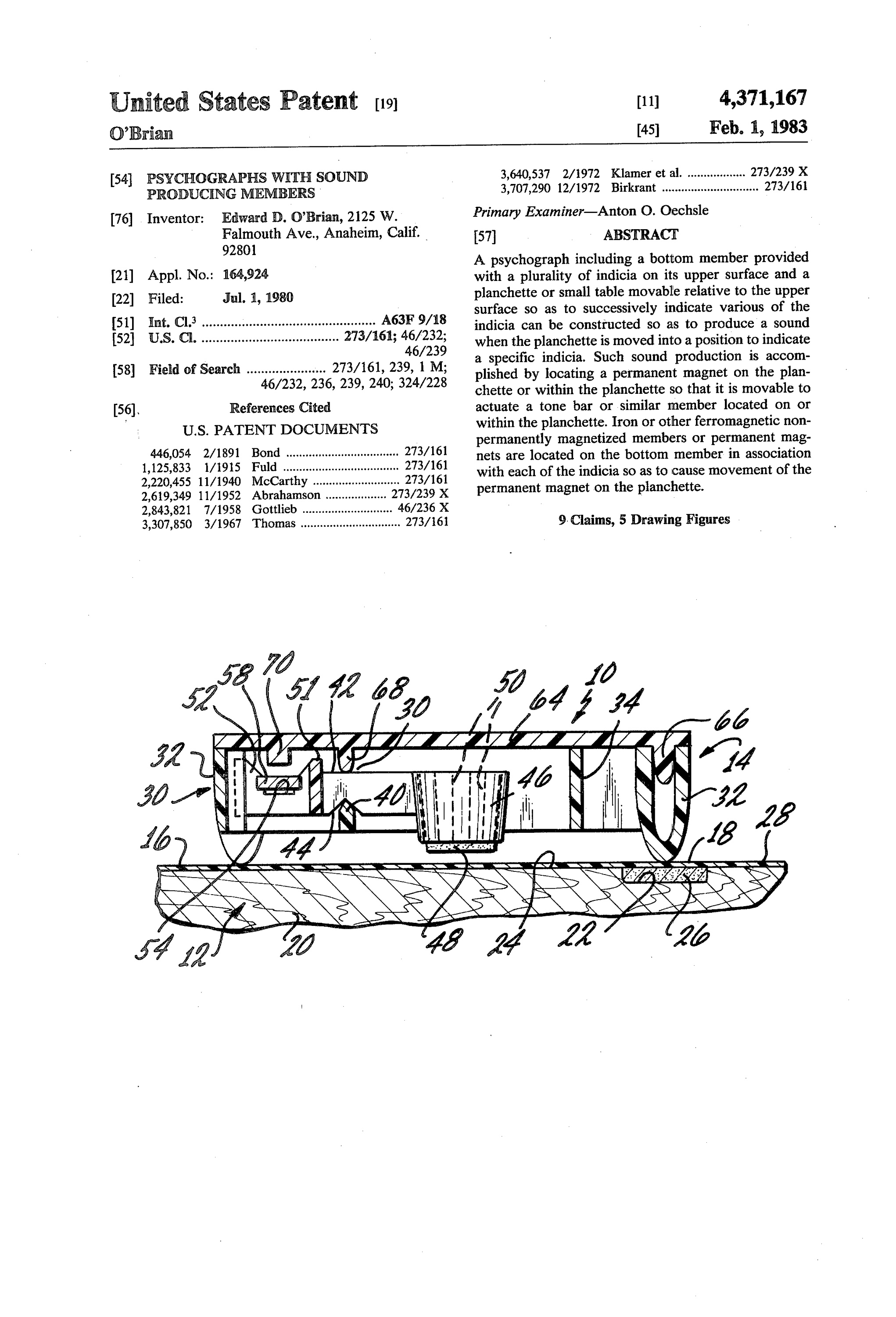
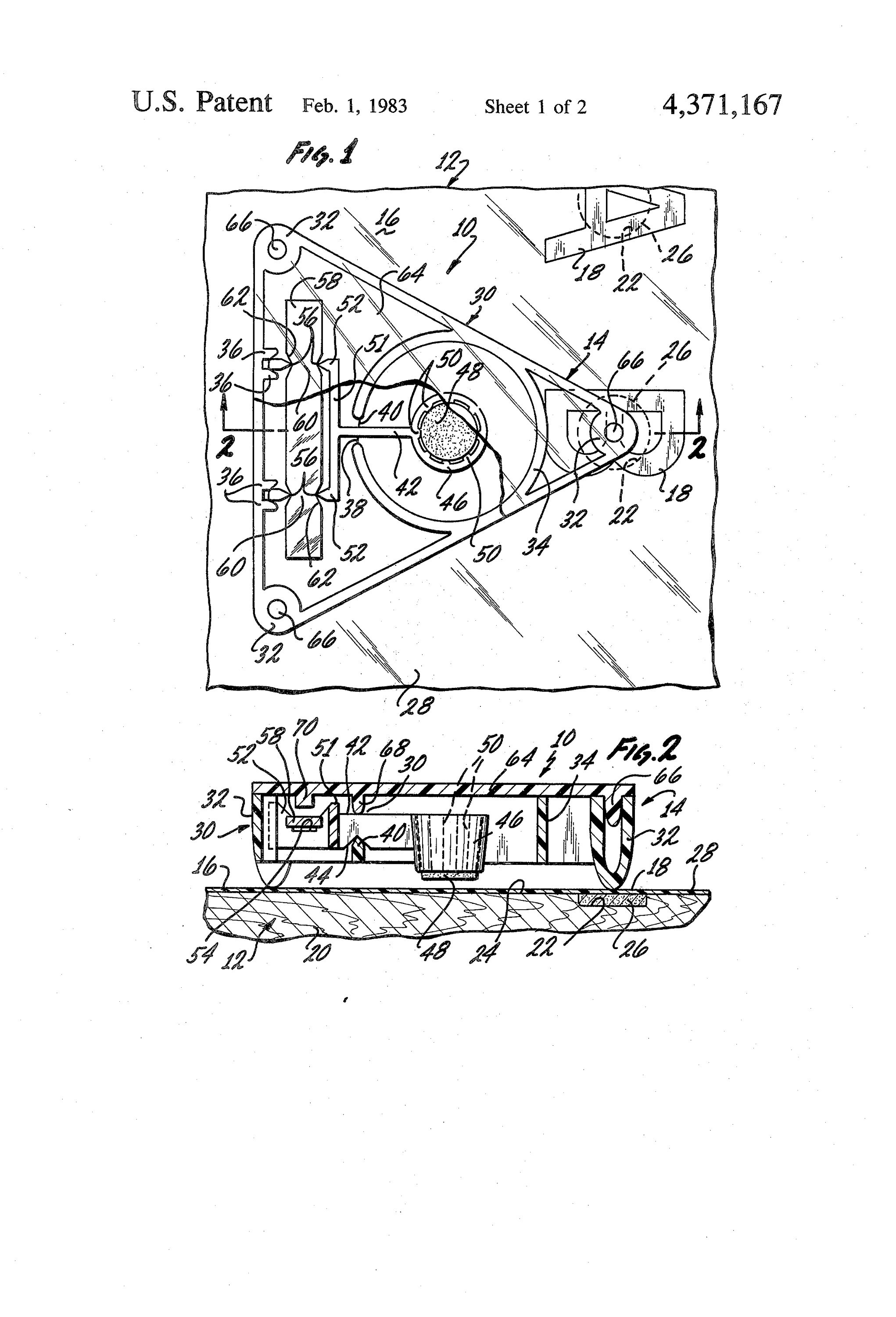
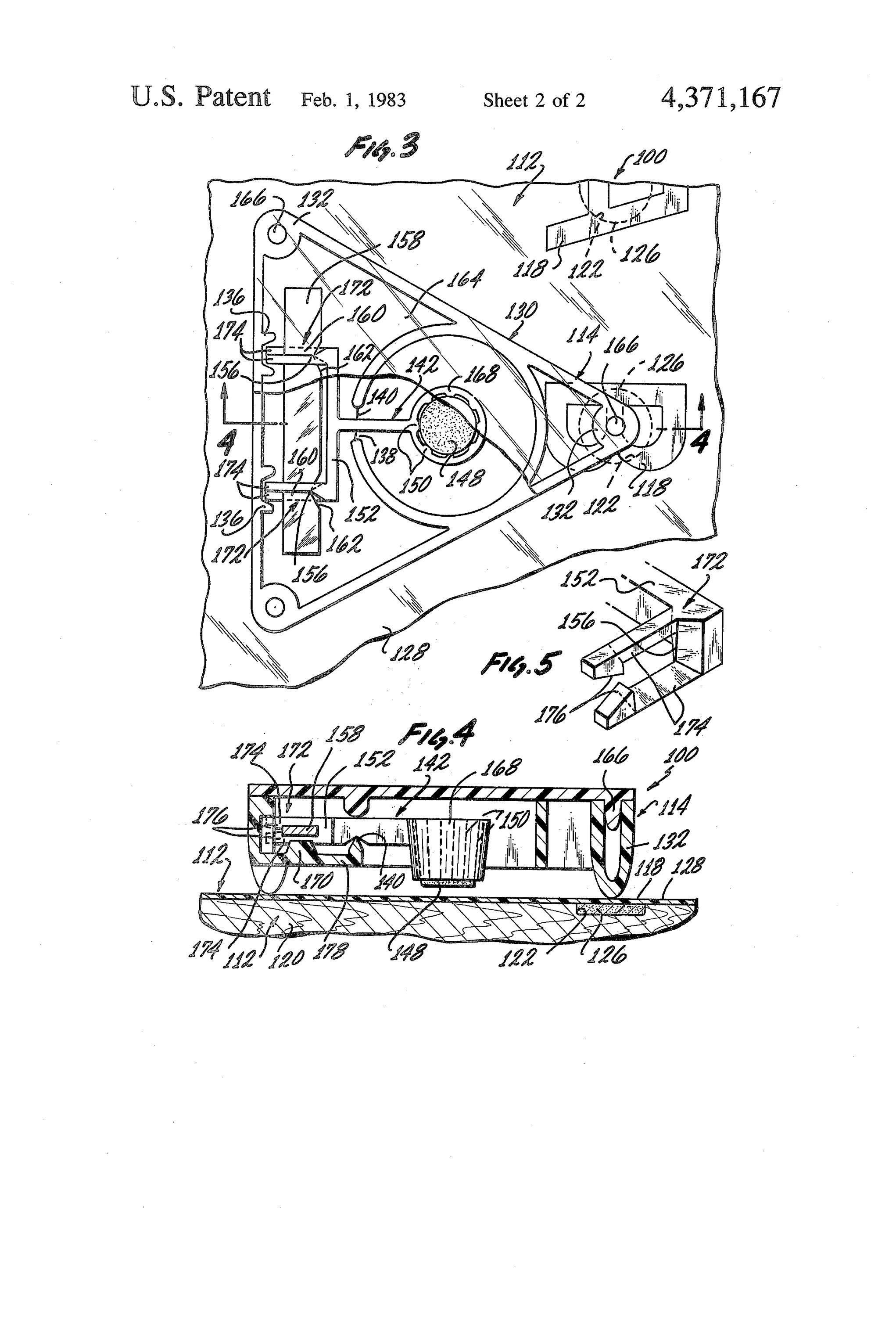
Psychographs with Sound Producing MembersUS 4,371,167 · Edward D. O'Brian, Anaheim, CaliforniaFiled 1 July 1980 · granted 1 February 1983 A psychograph that rings. A lever inside the planchette carries a small magnet; as it passes over iron beneath a letter, the magnet pulls the lever and its tone bar strikes. The word psychograph, a century and a quarter after Wagner, still in use. The full patent (PDF, 829 KB) · Google Patents
IV.Fortune Dials, for Comparison
Dials that are spun, geared or turned by a knob rather than moved by the sitters' touch. They answer by chance, and say so; I include them because the collectors file them with the rest, and because the difference is the whole point.
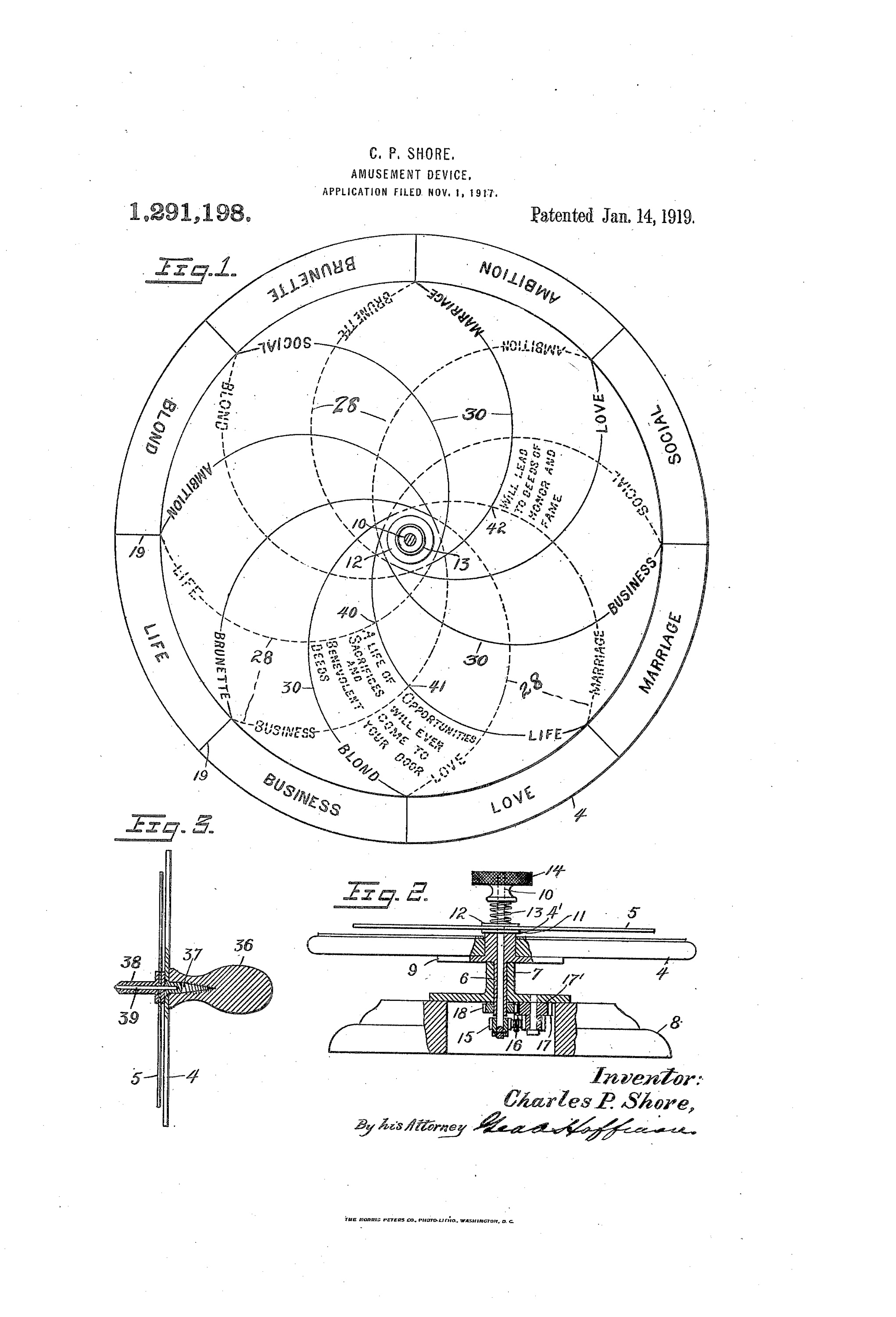
Amusement DeviceUS 1,291,198 · Charles P. Shore, Hicksville, New YorkFiled 1 November 1917 · granted 14 January 1919 A knob turns a transparent indicator disk one way and, through a gear train, a reading disk beneath it the other; where their curved lines cross, a fortune is read. The full patent (PDF, 730 KB) · Google Patents
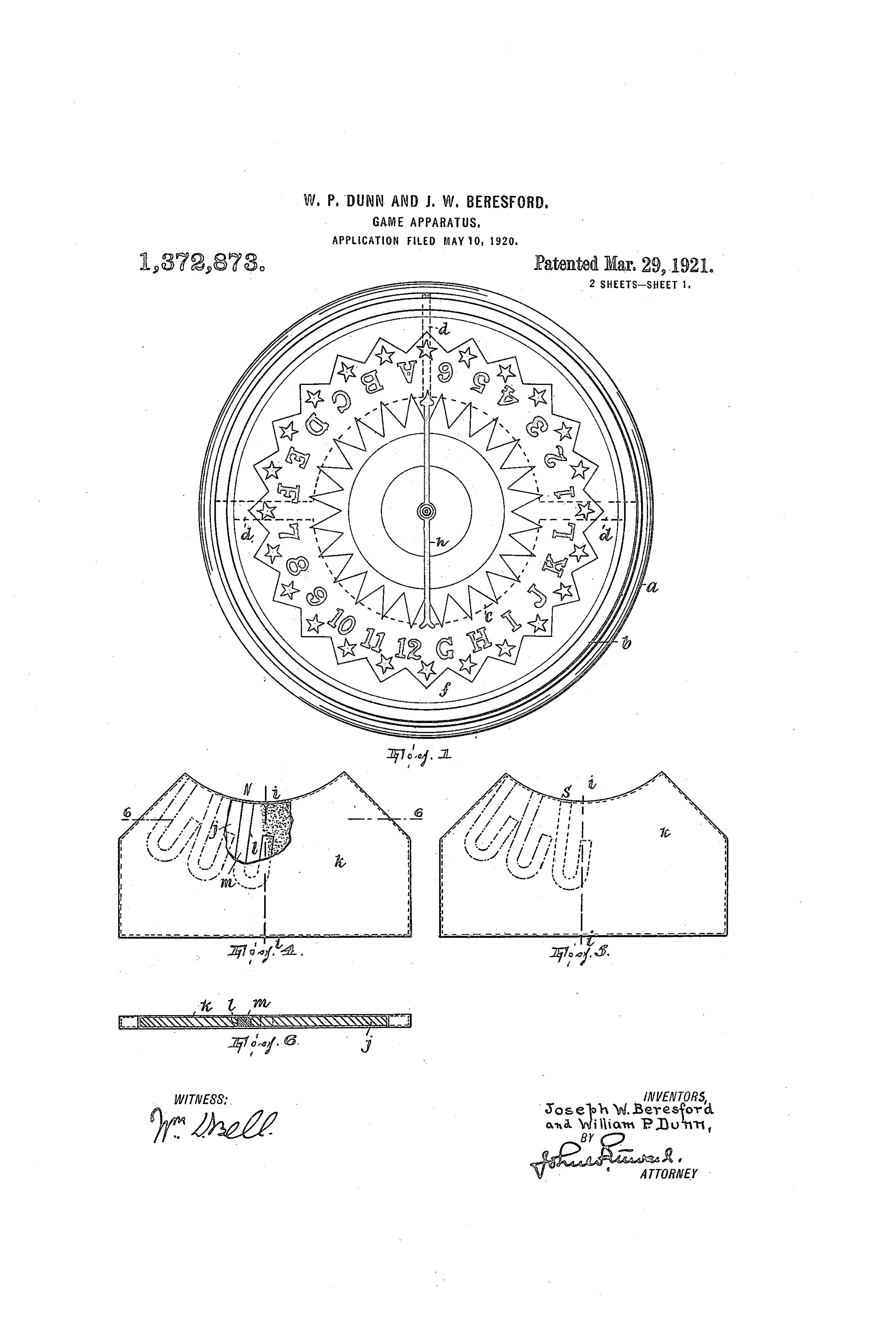
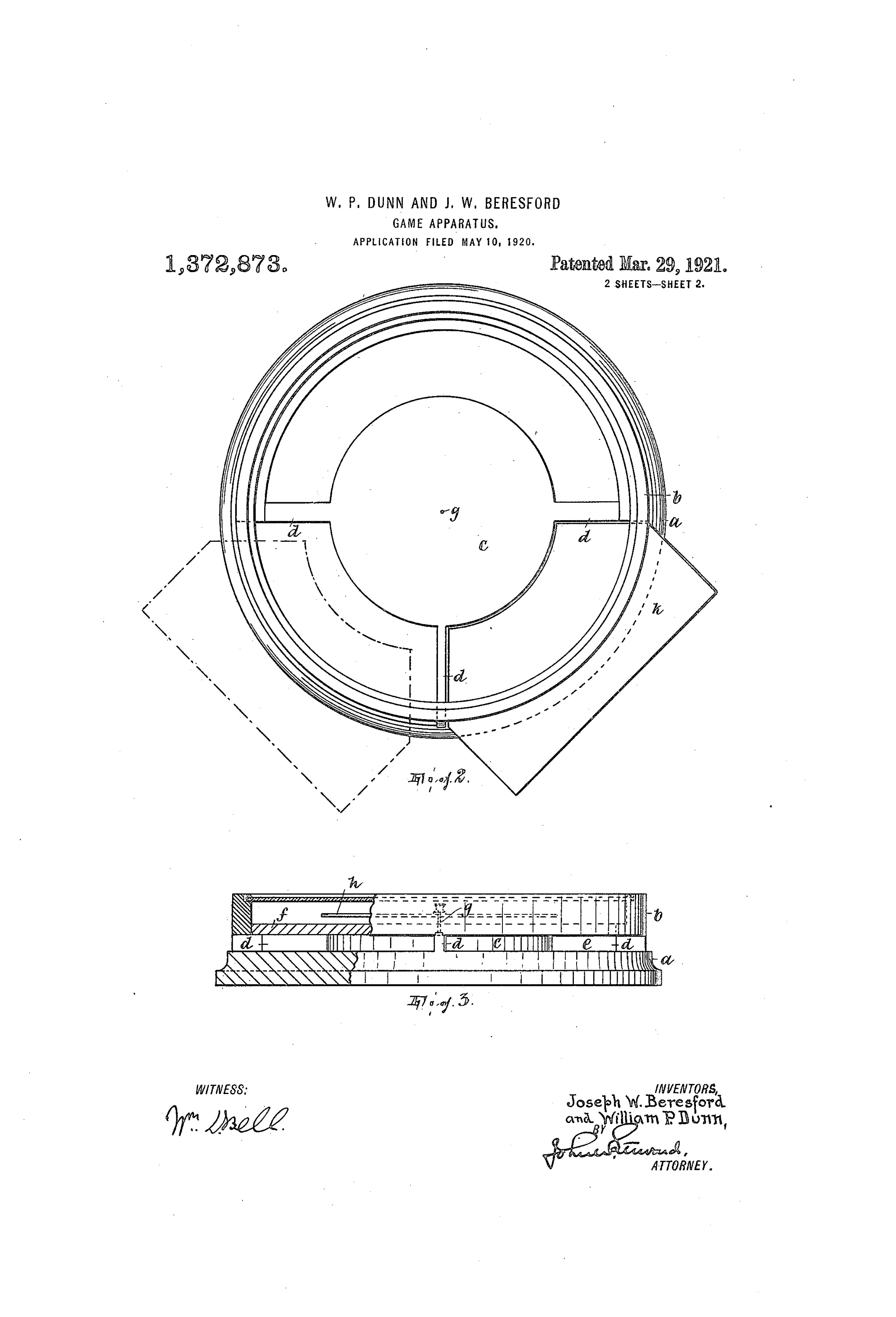
Game ApparatusUS 1,372,873 · William P. Dunn and Joseph W. Beresford, Paterson, New JerseyFiled 10 May 1920 · granted 29 March 1921 A magnetic needle over a dial of twenty-four indices, moved by look-alike actuators with magnets hidden off-centre inside them, which attract or repel it. The full patent (PDF, 429 KB) · Google Patents
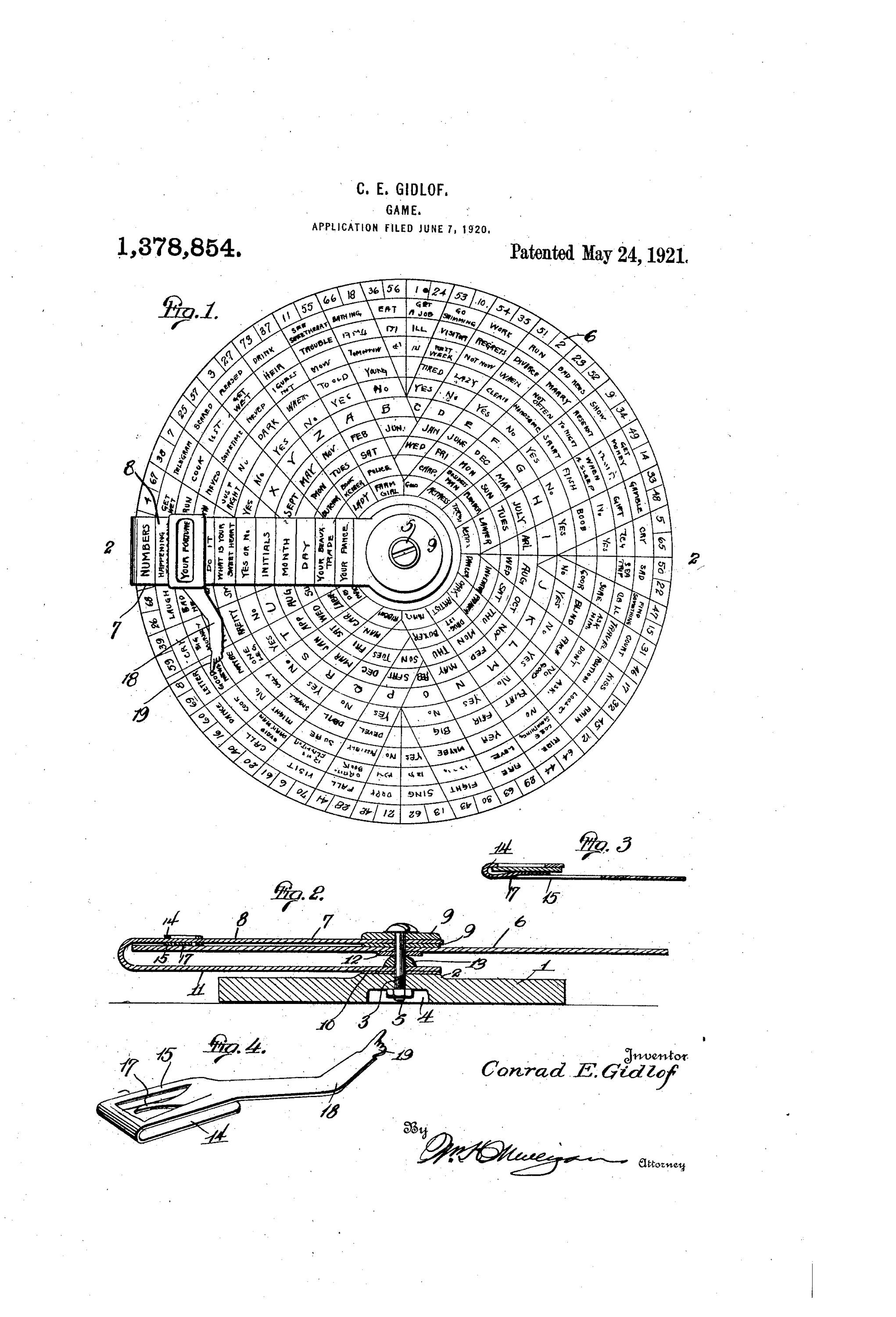
GameUS 1,378,854 · Conrad E. Gidlof, Elizabeth, New JerseyFiled 7 June 1920 · granted 24 May 1921 A sliding finger chooses a question on a plate; a large disk is spun beneath, and its pointer stops at the answer. The full patent (PDF, 349 KB) · Google Patents
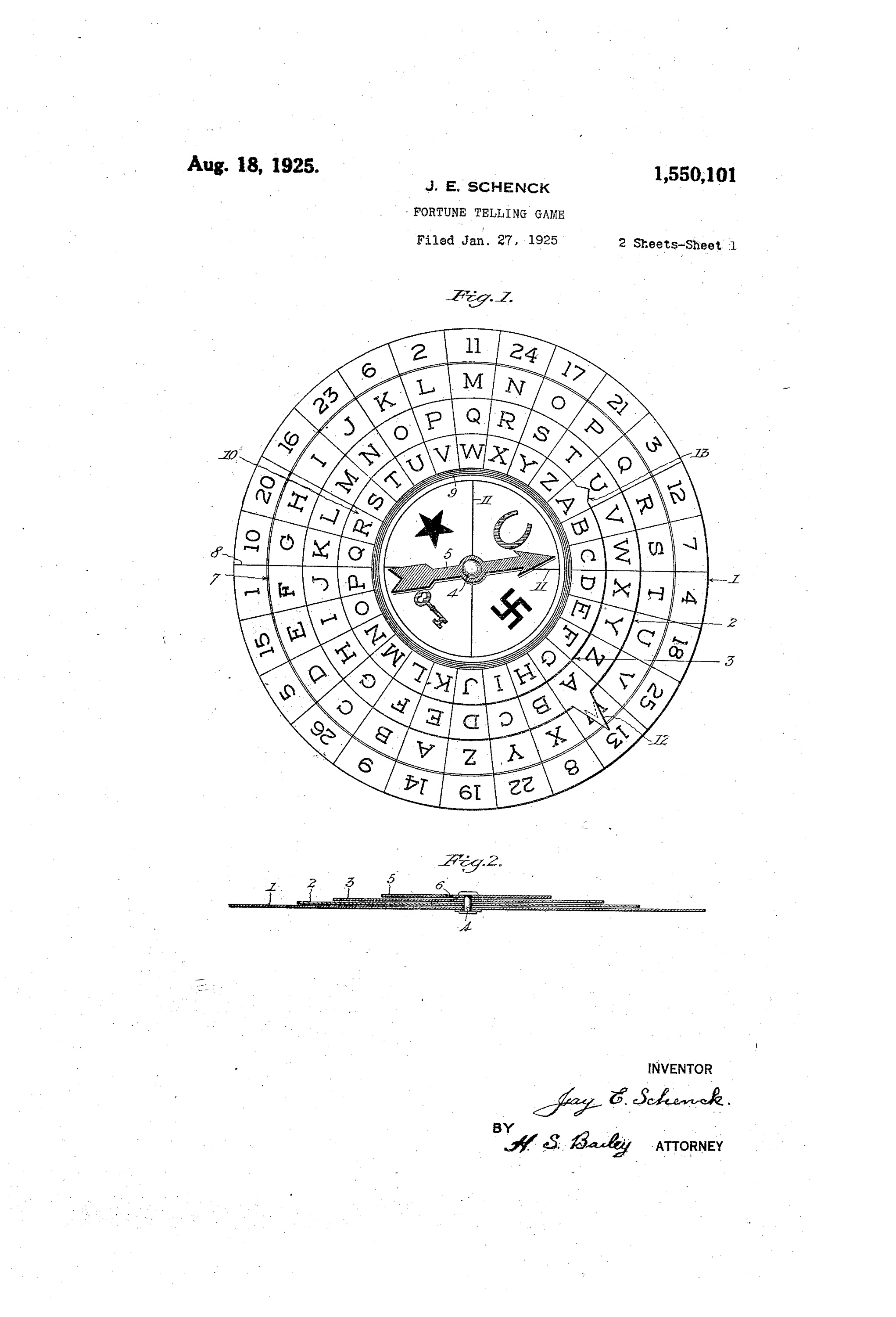
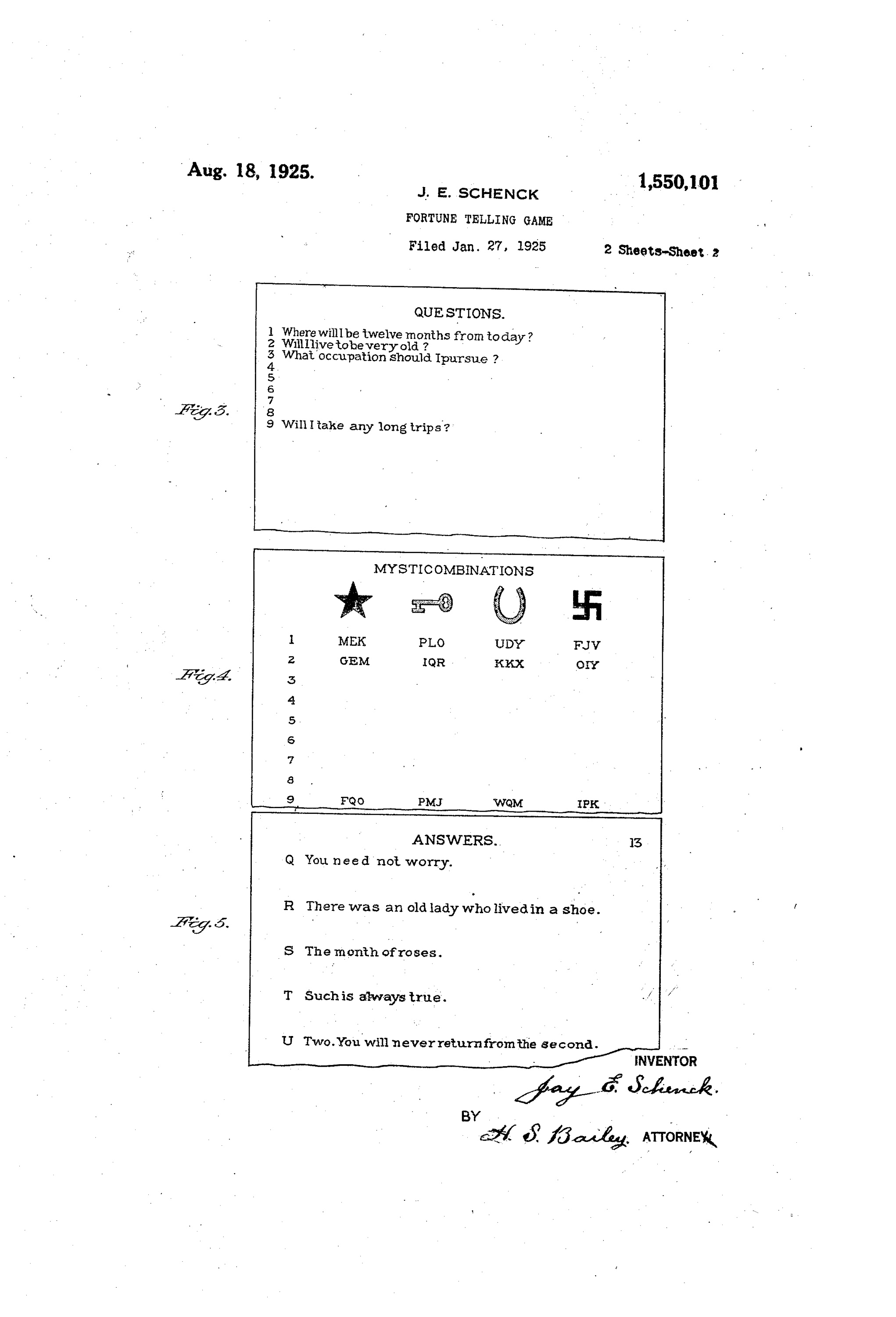
Fortune-Telling GameUS 1,550,101 · Jay E. Schenck, Fitzsimons, ColoradoFiled 27 January 1925 · granted 18 August 1925 A spinning arrow over three stacked disks, and a booklet of answers keyed to the letters the disks line up. The full patent (PDF, 462 KB) · Google Patents
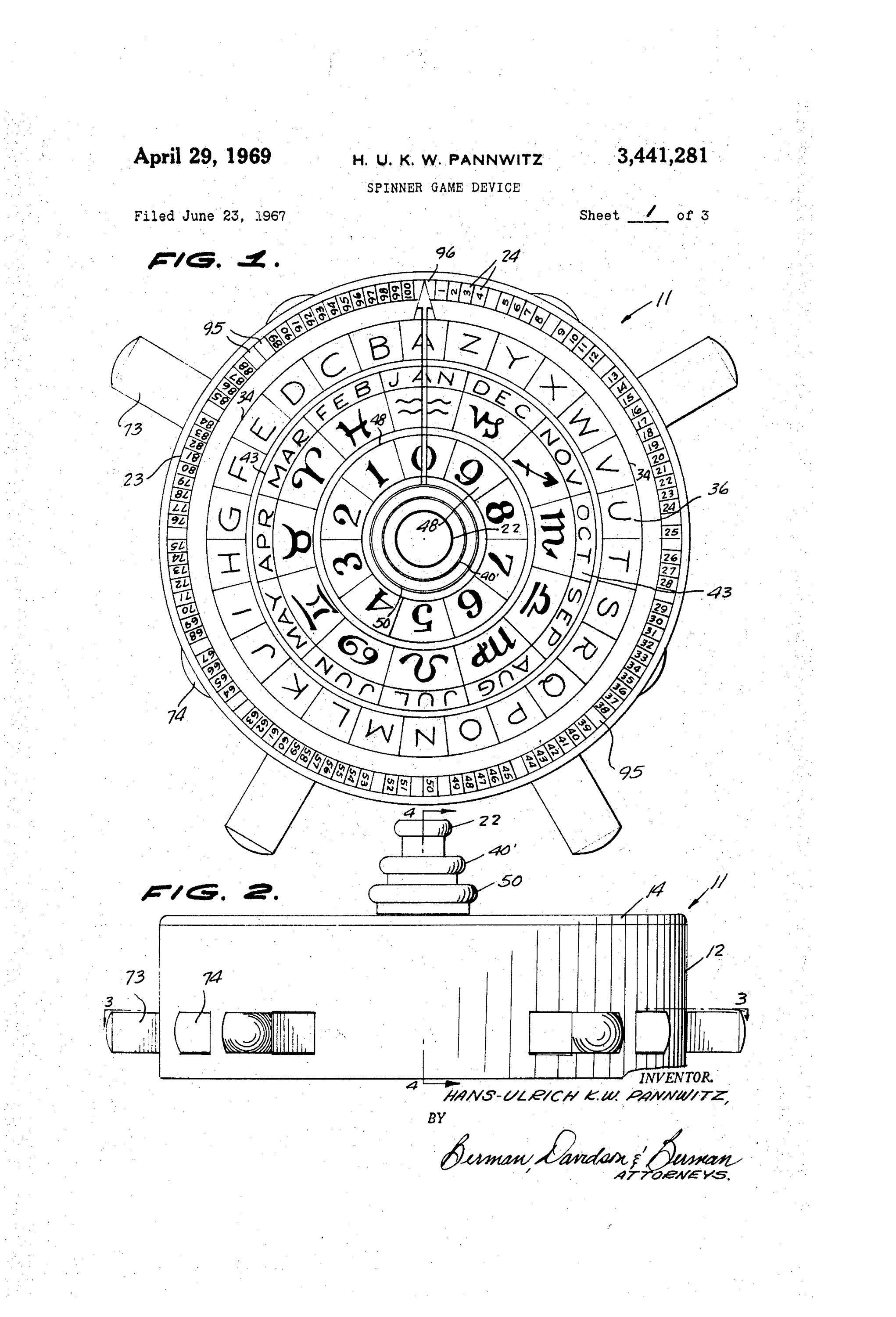
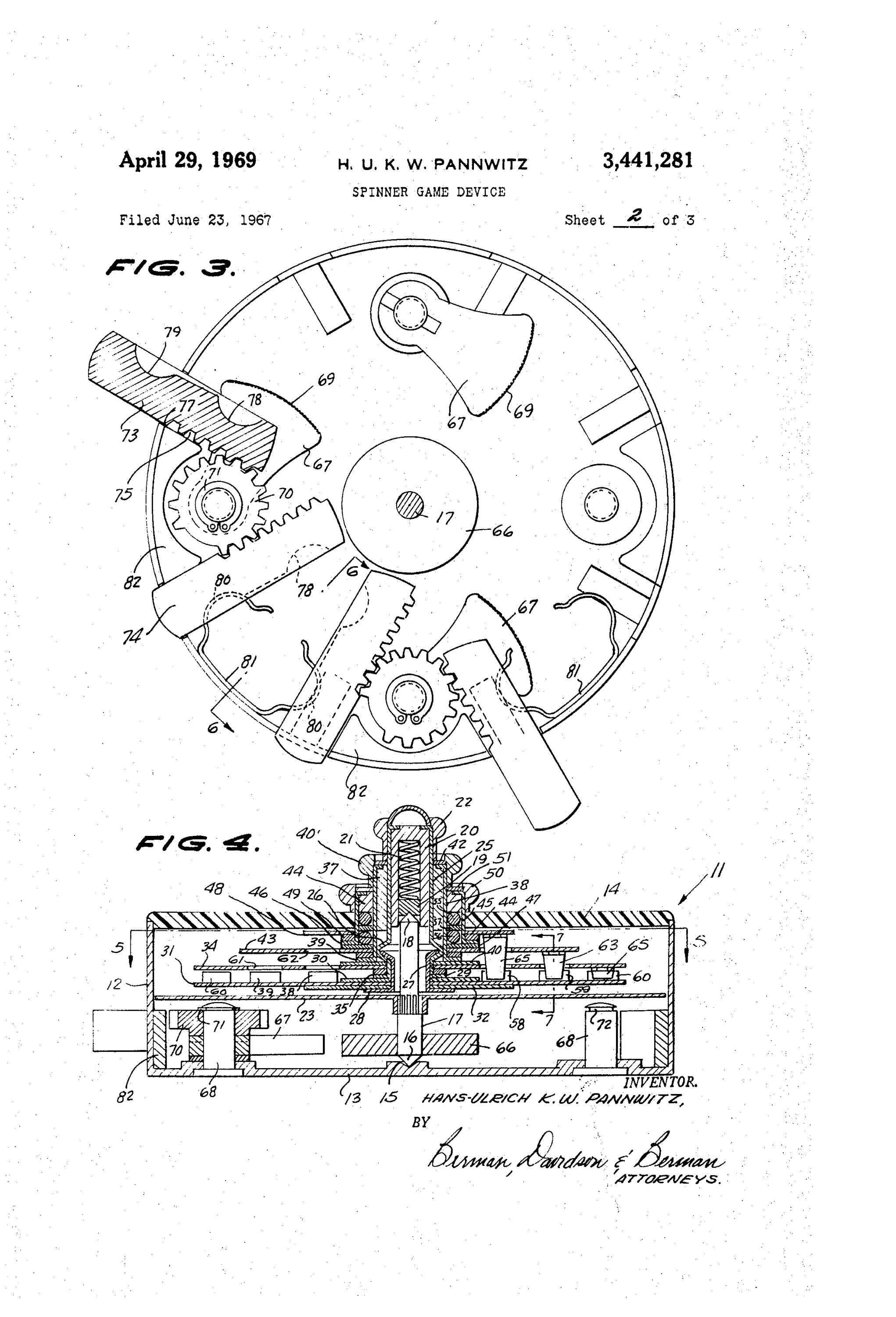
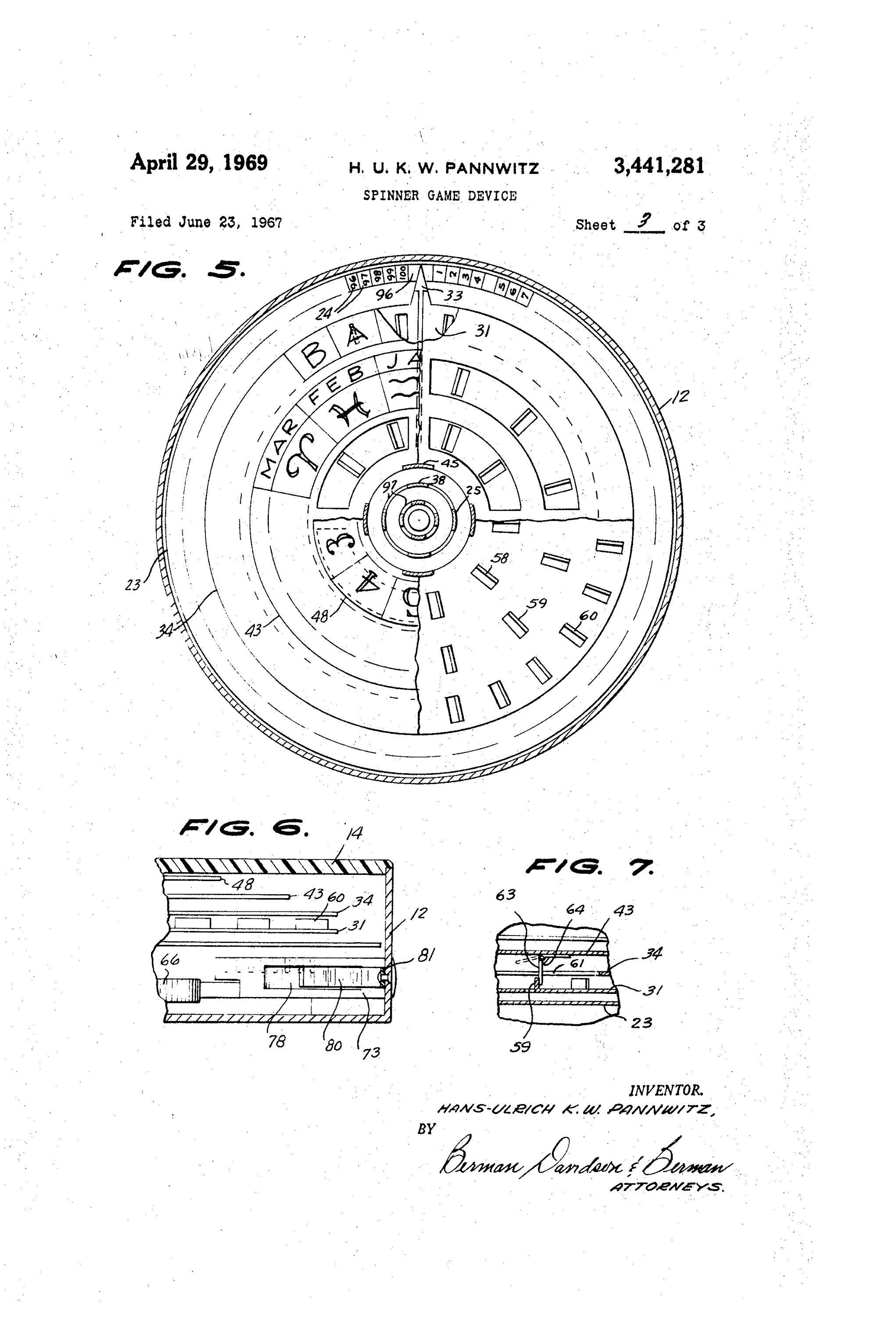
Spinner Game DeviceUS 3,441,281 · Hans-Ulrich K. W. Pannwitz, Filed 23 June 1967 · granted 29 April 1969 A rack bar, pushed, spins a numbered disc through a friction cam; data wheels set with knobs frame the question, and the number is read against a list. The full patent (PDF, 787 KB) · Google Patents
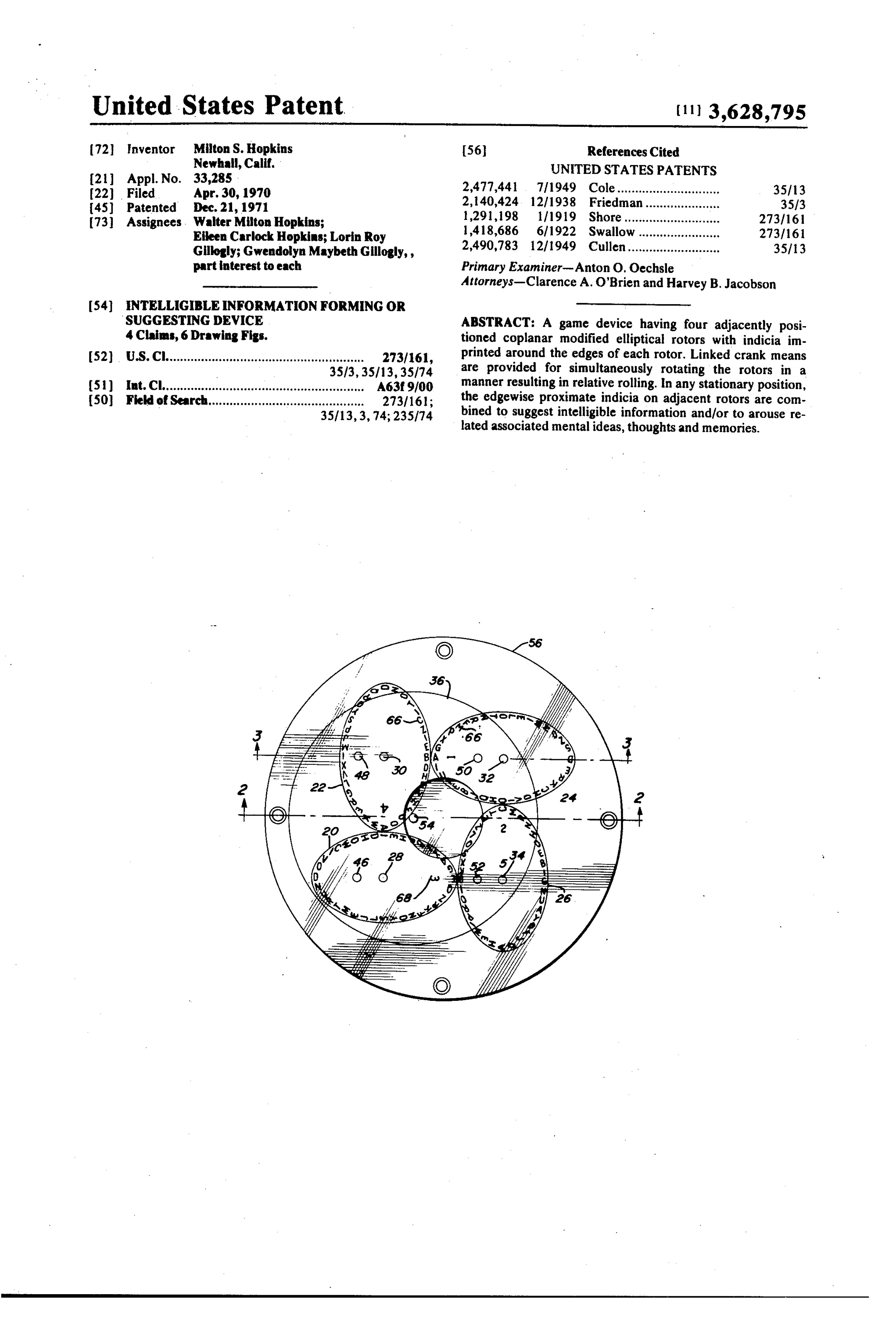
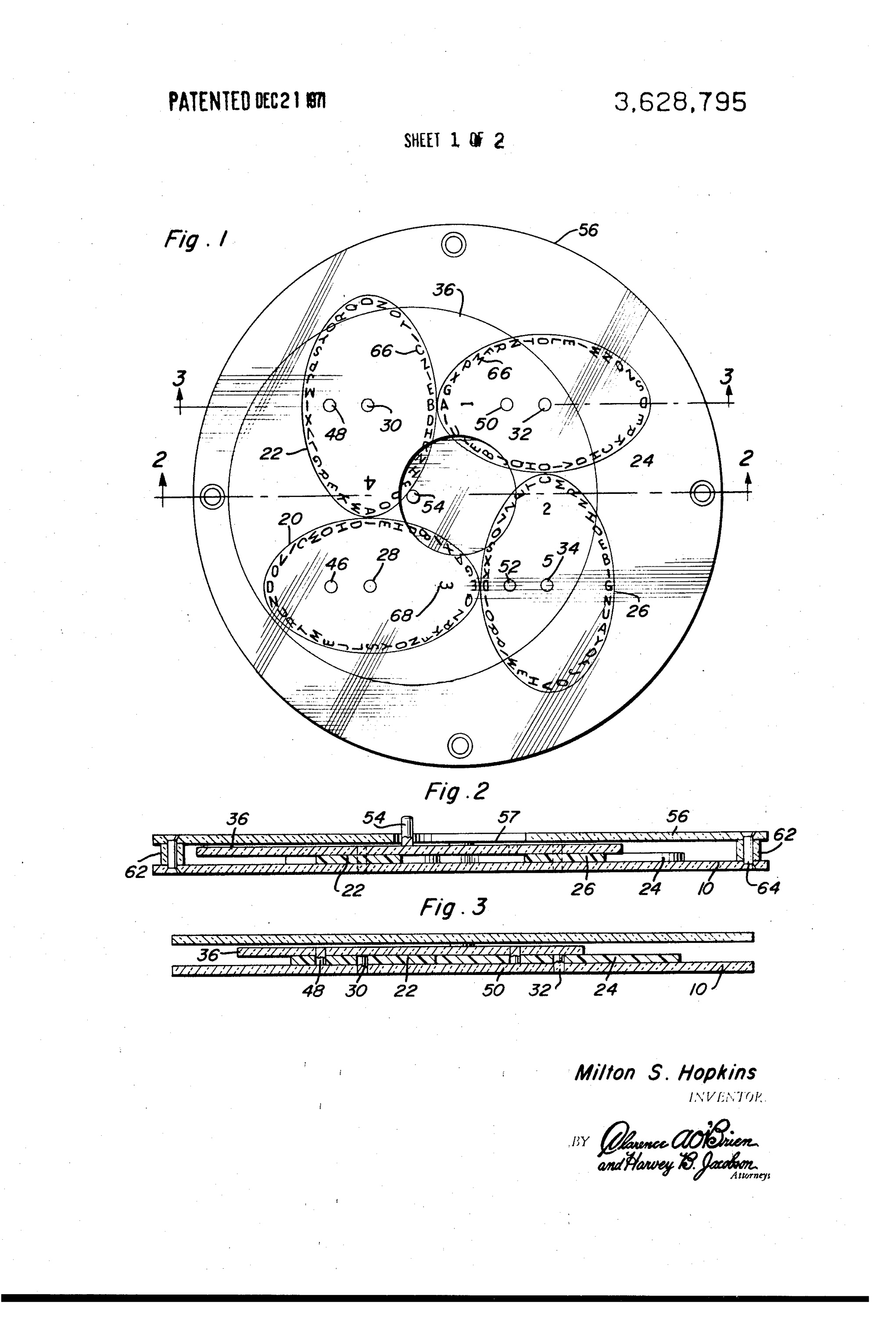
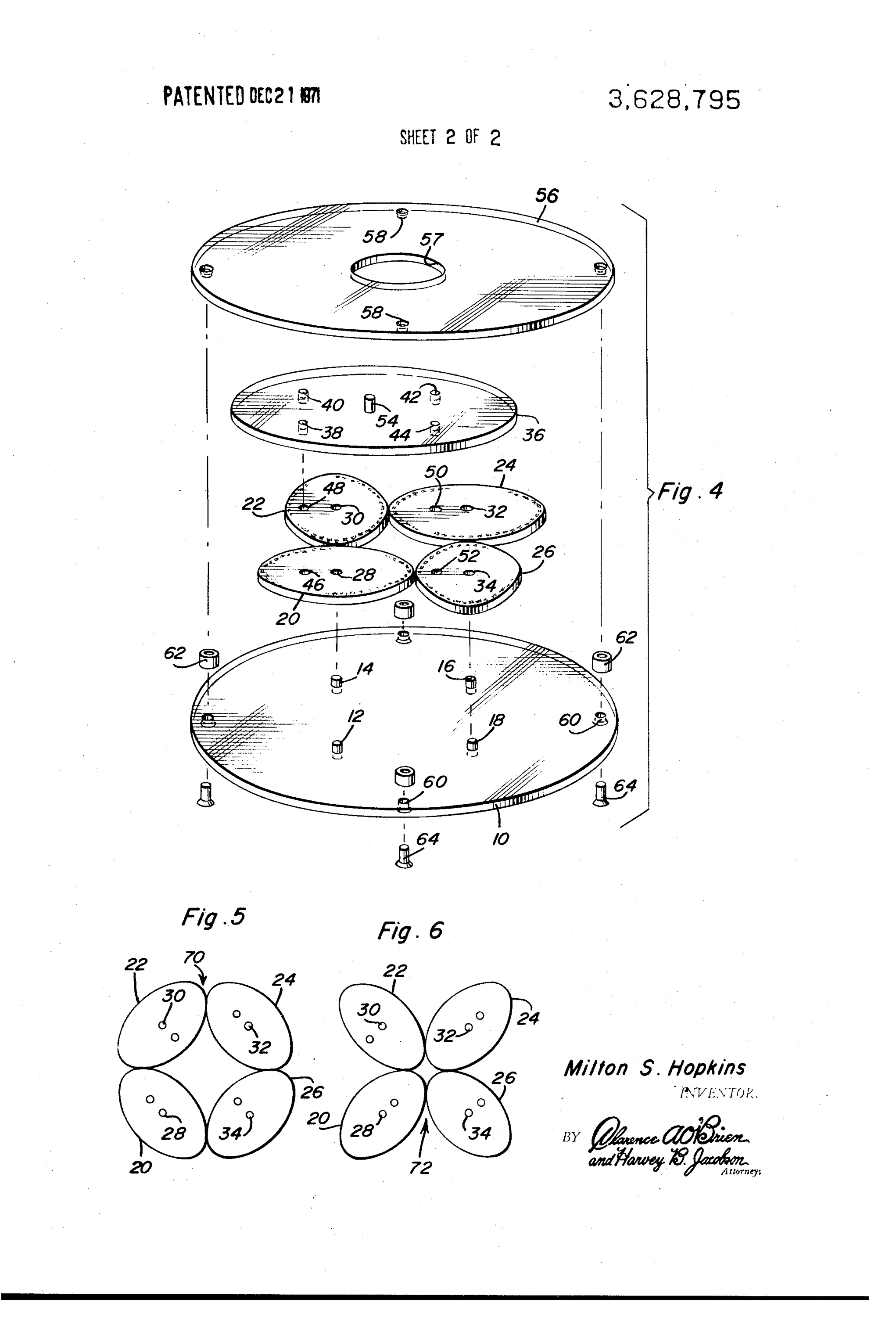
Intelligible Information Forming or Suggesting DeviceUS 3,628,795 · Milton S. Hopkins, Newhall, CaliforniaFiled 30 April 1970 · granted 21 December 1971 Four elliptical rotors rolling against one another, turned by a knob or simply by tilting the case; the letters are read where neighbouring rotors come closest. The full patent (PDF, 449 KB) · Google Patents
V.What a Patent Proves
A patent protects a mechanism. It does not test what the mechanism is said to do. No examiner in London or Washington was ever asked whether the dead were speaking through a dial, only whether the dial was new; which is how the same office could grant a Spirit Wheel and a Toy or Game, and how William Fuld could write into his own patent that the frame moves “by the involuntary muscular motion of the hands of the players, or through some other agency,” and leave it there.
Read together, these drawings are a record of the question rather than of an answer: a hundred and thirty years of inventors trying to make the faintest movement of the hand visible, legible and fair. Hare wanted the same thing with his screens and balances. That is why they belong in this house. The reproductions I make are of his instruments, not of these; but anyone who wants to understand what the spiritoscope was trying to do should see what came after it.